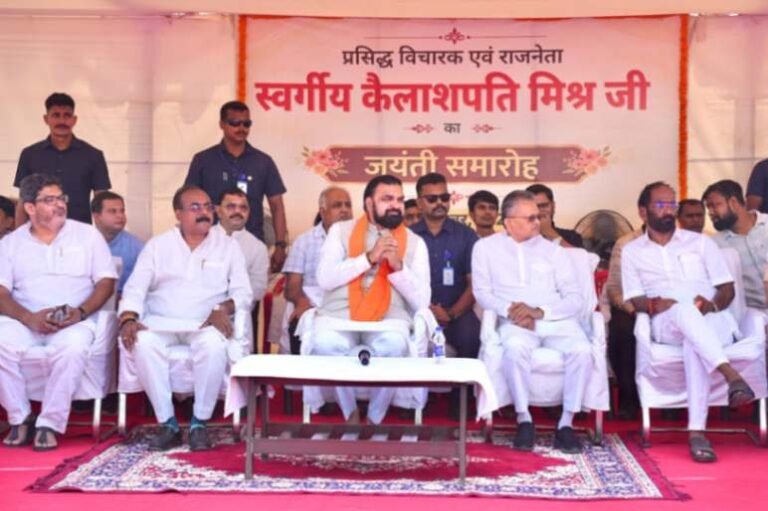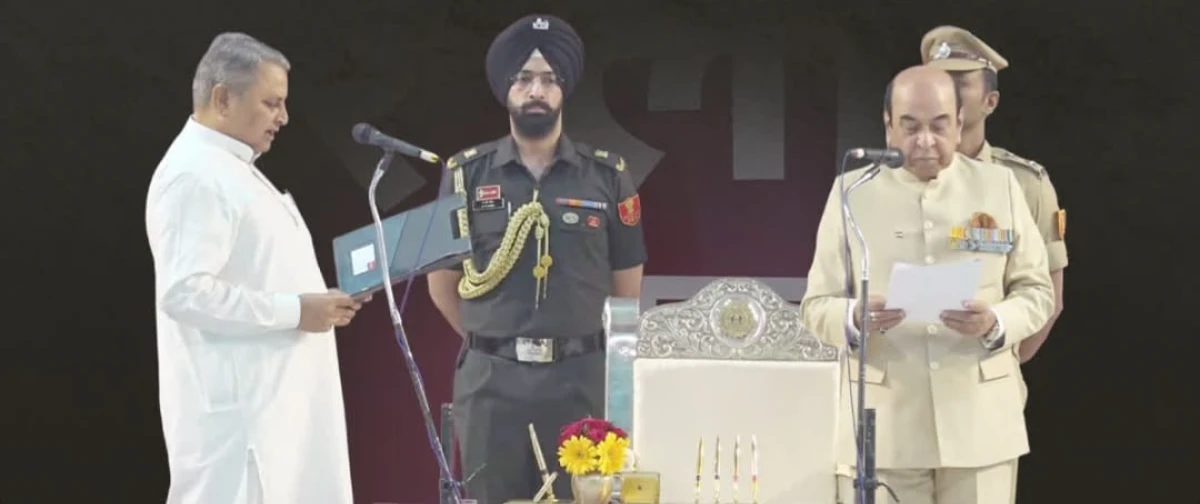
Vijay Kumar Choudhary takes oath.
By Neeraj Kumar
Patna: The political tectonic plates in Patna shifted decisively on Wednesday as a new administration took the oath of office, signaling a sophisticated recalibration of the National Democratic Alliance (NDA) in Bihar. In a move that defines political pragmatism, Samrat Choudhary has assumed the office of Chief Minister, while the structural integrity of the cabinet is anchored by the appointment of two of the Janata Dal (United)’s most seasoned heavyweights to the Deputy Chief Minister roles.
This arrangement represents a deliberate “administrative vanguard”—placing the JD(U)’s most trusted veterans as the stabilizing force within a cabinet led by the BJP. The swearing-in ceremony, held in the capital, formally elevated Samrat Choudhary, Vijay Kumar Choudhary, and Bijendra Prasad Yadav, establishing a power dynamic built on the fusion of BJP’s leadership with the JD(U)’s institutional memory.
Key Players in the New Administration
Samrat Choudhary (BJP), Chief Minister: The primary representative of BJP’s leadership and ideological shift in the alliance.
Vijay Kumar Choudhary JD(U), Deputy CM: Nitish Kumar’s premier strategist; the intellectual bridge for policy continuity.
Bijendra Prasad Yadav JD(U), Deputy CM : The bridge between the socialist JP Movement roots and modern infrastructure; a symbol of permanence.
While the leadership hierarchy has been reordered, the governance framework remains tethered to the “Nitish Model,” a system that the newly appointed Deputy CMs are tasked with protecting and executing within this transformed alliance.
The Strategist – Vijay Kumar Choudhary
Vijay Kumar Chaudhary’s elevation to Deputy Chief Minister is the logical culmination of his standing as the “most trusted strategist” within the JD(U). In a political environment defined by volatility, Choudhary’s appointment is viewed by observers as a guarantee of ideological alignment with Nitish Kumar’s vision. Choudhary himself framed his new responsibility as the direct “result of the trust” placed in him by the veteran leader, signaling a tenure dedicated to the preservation of the JD(U)’s established governance style.
Chaudhary’s career trajectory blends academic rigor with high-stakes political maneuvering. After earning an MA in History from Patna University in 1979, he began a professional career as a Probationary Officer with the State Bank of India in Trivandrum. However, the death of his father, Jagdish Prasad Choudhary—a freedom fighter and three-term Congress MLA—drew him back to Samastipur. Entering politics in a 1982 by-election, he served as a Congress MLA and General Secretary before transitioning to the JD(U )in 2005, where he rapidly became an indispensable asset.
Multifaceted Administrative Experience
Legislative Leadership: Served with distinction as the Speaker of the Bihar Legislative Assembly following the 2015 elections.
Key Portfolios: A veteran administrator who has managed the complex demands of the Finance, Education, Water Resources, and Building Construction ministries.
Party Management: Provided organizational stability as the JD(U) State President (2010) and served as the party’s Chief Spokesperson and General Secretary.
Ch0udhary’s commitment to the “Nitish Model” remains absolute, despite the inclusion of the BJP and three other parties in the current framework. He famously remarked that “there can be no second Nitish Kumar,” emphasizing that the administration will strictly adhere to the policies, programs, and work style that have defined the last two decades of Bihar’s development. This image of the professional strategist stands in sharp relief against the grassroots, veteran longevity of his colleague, Bijendra Prasad Yadav.
THE POWER OF PERMANENCE: The Veteran – Bijendra Prasad Yadav
At 79, Bijendra Prasad Yadav is the “permanent” face of the Bihar Cabinet, a figure whose presence offers essential continuity amidst the state’s frequent political realignments. As a nine-time MLA for Supaul, Yadav’s inclusion is more than a gesture of seniority; it is a recognition of his status as a repository of institutional memory. Having served as a minister consistently since 2005—and notably having served as a minister during the RJD era—Yadav remains an unwavering fixture in the cabinet regardless of whether the JD(U) aligns with the NDA or the Mahagathbandhan.
Yadav’s legacy is inextricably linked to the transformation of the state’s Energy Sector. He spearheaded the “Electricity in Every Home” campaign, a cornerstone of the state’s modernization, and implemented the popular 125-unit free power initiative. His political lineage is deeply rooted in the grassroots; the son of Sukhram Yadav, a local Mukhiya, Bijendra Yadav rose through the ranks of the JP Movement to become one of the most influential voices in the Kosi region.
Career Milestone Timeline
1970s: Entered the political arena as a student activist during the JP Movement.
1990: Secured his first assembly victory on a Janata Dal ticket, defeating Congress heavyweight Pramod Kumar Singh in Supaul.
Pre-2005: Served as a Minister within the RJD government, establishing his administrative credentials.
2005 – Present: Maintained a continuous presence as a Cabinet Minister under Nitish Kumar, managing Energy, Finance, and Planning.
Current: Elected to his ninth term as MLA for Supaul.
Beyond administration, Yadav serves as the JD(U)’s blunt political defender. Following the ceremony, he dismissed RJD’s Tejashwi Yadav’s critiques by pointedly asking which “school of politics” the younger leader had emerged from, noting the shared roots in the original Janata Dal. His pragmatic approach extended to family matters, stating that the absence of Nitish Kumar’s son, Nishant, was a personal matter of career choice. This transition from individual veteran profiles underscores a broader collective framework that defines the new government.
About the Author