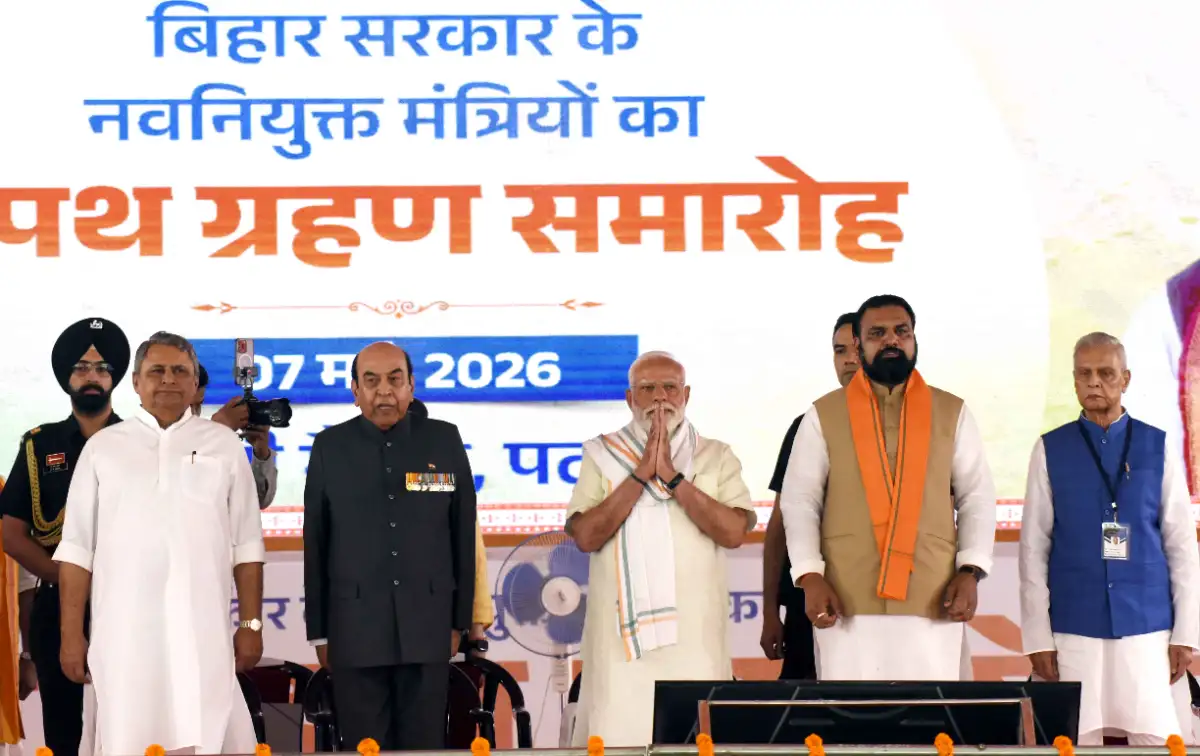
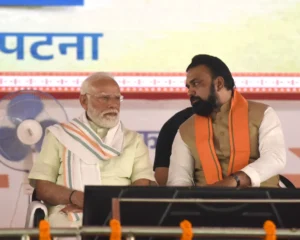
A grand swearing-in ceremony was held at Gandhi Maidan in Patna on May 7 as Bihar Chief Minister Samrat Choudhary expanded his cabinet. Prime Minister Narendra Modi attended the function. Photo: Aftab Alam Siddiqui
By Alok Mohit
Patna: Twenty-two days after taking oath as Bihar chief minister, Samrat Choudhary on Thursday (May 7, 2026) expanded his council of ministers, inducting 32 new members in a grand swearing-in ceremony held at Gandhi Maidan here.
With this, the Bihar cabinet now has 35 members, including the chief minister and two deputy chief ministers, while one berth has been kept vacant. The state can have a maximum of 36 ministers.
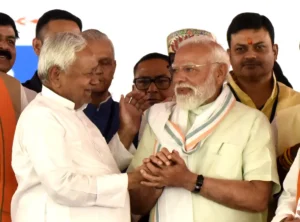
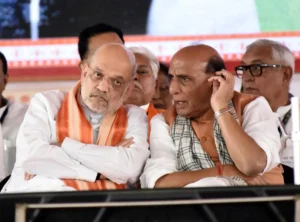
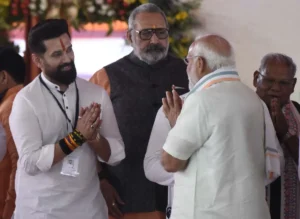
The ceremony was attended by Prime Minister Narendra Modi, Union defence minister Rajnath Singh, Union home minister Amit Shah, senior BJP leaders, and JD(U) national president and former chief minister Nitish Kumar.
The expanded cabinet includes 15 ministers from the BJP, 13 from the JD(U), two from the Lok Janshakti Party (Ram Vilas), and one each from the Hindustani Awam Morcha and Rashtriya Lok Morcha. Deputy chief ministers Vijay Kumar Chaudhary and Bijendra Prasad Yadav, who had taken oath along with the chief minister on April 15, belong to the JD(U).
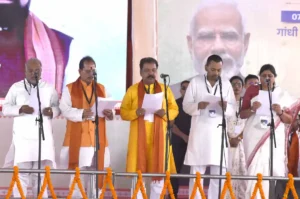
The ministers who took oath on Thursday include Vijay Kumar Sinha, Ram Kripal Yadav, Kedar Gupta, Nitish Mishra, Mithlesh Tiwari, Rama Nishad, Dilip Jaiswal, Pramod Chandravanshi, Lakhendra Kumar Raushan, Sanjay Singh Tiger, Kumar Shailendra, Nand Kishore Ram, Ramchandra Prasad, Arun Shankar Prasad and Shreyasi Singh from the BJP.
From the JD(U), those sworn in were Nishant Kumar, Shravan Kumar, Madan Sahni, Leshi Singh, Shweta Gupta, Bhagwan Singh Kushwaha, Damodar Rawat, Shailesh Kumar alias Bulo Mandal, Sunil Kumar, Sheela Kumari, Ratnesh Sada, Jama Khan and Ashok Choudhary.
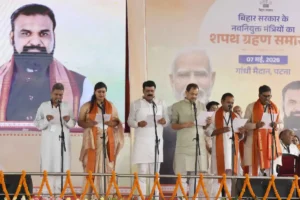
From the Lok Janshakti Party (Ram Vilas), Sanjay Paswan and Sanjay Singh took oath, while Santosh Kumar Suman represented the Hindustani Awam Morcha (Secular). Deepak Prakash was inducted from the Rashtriya Lok Morcha (RLM) quota.
The notable omissions in the new ministry from the previous cabinet are BJP leaders Mangal Pandey, Narayan Prasad and Surendra Mehta. Sources said Mangal Pandey, who is BJP’s state in-charge for West Bengal, could be assigned a role at the national level or within the party organisation after the party’s outstanding performance in the recently concluded assembly elections in the eastern state.
The new ministry has also renewed discussion around the influence of political families in Bihar politics. Several ministers in the expanded cabinet come from established political backgrounds, reflecting the continuing role of legacy networks in the state’s power structure.
One of the major highlights of the expansion was the induction of Nishant Kumar, son of former chief minister Nitish Kumar, into active governance for the first time. Nishant formally joined the JD(U) in March this year and is now being viewed within the party as a prominent next-generation face. A software engineering graduate from BIT Mesra, he had largely stayed away from active politics for years.
Similarly, Santosh Kumar Suman, son of former chief minister Jitan Ram Manjhi, retained his place in the cabinet, while Nitish Mishra, son of former chief minister Jagannath Mishra, also returned to the ministry.
The trend is visible beyond these three leaders as well. Samrat Choudhary is the son of veteran socialist leader and former minister Shakuni Choudhary, while Ashok Choudhary is the son of former legislator Mahavir Choudhary. Shreyasi Singh is the daughter of former Union minister and MP Digvijay Singh. Deepak Prakash, inducted from the RLM quota, is associated with veteran leader Upendra Kushwaha.
The composition of the cabinet also reflects the NDA’s effort to strike a wider social balance. Backward and Extremely Backward Classes (EBCs) have received significant representation, with leaders such as Madan Sahni, Rama Nishad and Damodar Rawat representing communities like Mallah, Kanu and Dhanuk. The Vaishya, Yadav and Kushwaha communities also have a notable presence through ministers such as Dilip Jaiswal, Ram Kripal Yadav and Bijendra Prasad Yadav.
The cabinet also includes prominent upper caste faces such as Vijay Kumar Sinha, Nitish Mishra and Shreyasi Singh, while Dalit and Mahadalit communities have representation through leaders like Ashok Choudhary, Ratnesh Sada, Nand Kishore Ram and Sanjay Paswan. Muslim representation has been retained through Jama Khan.
Speaking after taking oath, Ram Kripal Yadav said serving the people of Bihar would remain his top priority, while Kumar Shailendra described his induction as a vote of confidence by the party leadership and promised to work towards faster development in the state.
About the Author
Alok Mohit is a senior journalist based in Patna with decades of experience in mainstream journalism. He has previously served as Senior News Editor at Hindustan Times, Patna, and later at Hindustan Times, Chandigarh, where he played a key role in shaping news coverage and editorial direction. Known for his in-depth understanding of socio-political issues and strong editorial judgement, he continues to contribute insightful analysis and reporting on matters of public interest.
About the Author