
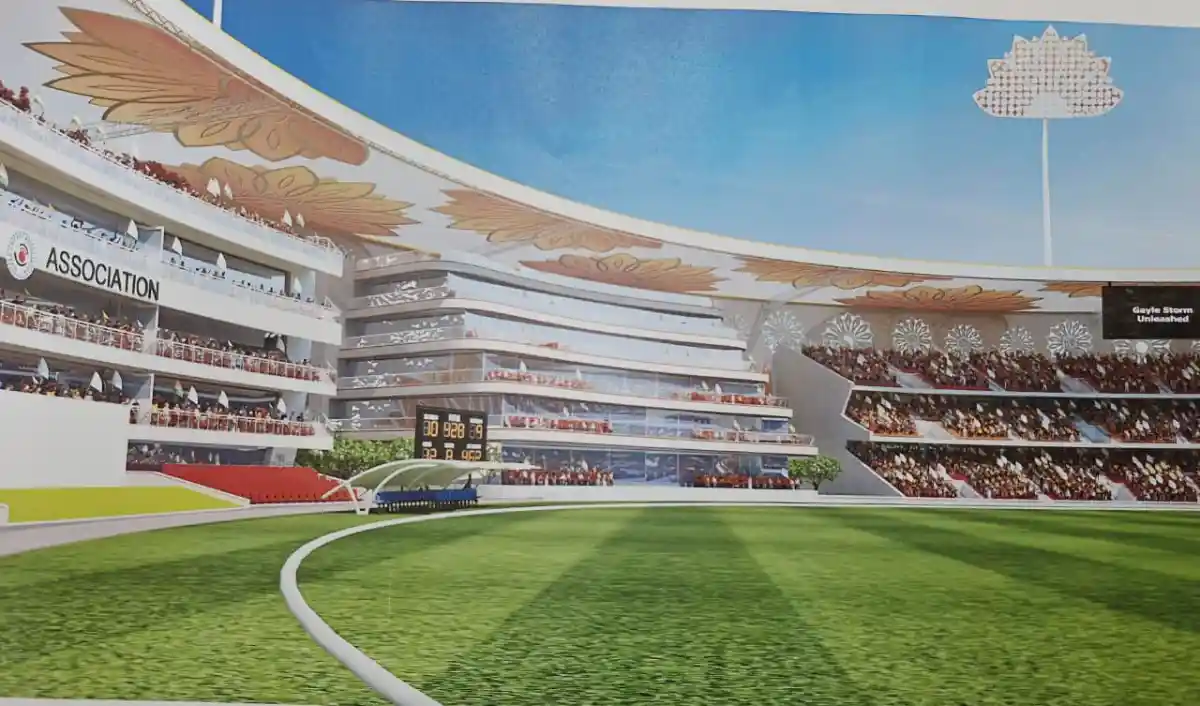
Model of to be redeveloped Moinul Ha Stadium Patna
By Anurag Ambasta
‘Aaiye Na Hamra Bihar Mein’, one of the most widely circulated phrases from a contemporary Bollywood popular culture, unfortunately evolved into a semiotic marker of lawlessness, rusticity, anti-social bravado, political cynicism, and social disorder, confining Bihar to a reductionist cultural signifier, which reinforced feelings of disgust and fear within public discourse. However, there is no room anymore for such cultural tropes as the meaning of the signifier is inverted and has been repositioned. Today, the phrase increasingly invites people from across to visit a Bihar that is diligent, ambitious, technologically amicable, and confidently a majoritarian English-speaking state than it once had been. This transformation can be experienced everywhere; be it in universities, colleges, schools, coaching institutes, libraries, cafés, restaurants, digital platforms, or even in small towns and semi-urban spaces. The real story of Bihar today, hence, lies not in outdated stereotypes, but in the resilience, educational hunger, labour, and linguistic confidence of the generation Z, who redefines and reconstructs images, and thereby challenge the stereotypically perceived reality.
There was a time when English carried the burden of nervousness in Bihar and it sat uneasily on young tongues; it often became a source of hesitation rather than expression, though the reality appears altogether a different today. In an attempt to democratize education and reduce academic exclusion for students from rural and marginalized backgrounds, the state in 1967 passed a resolution making English a non- compulsory subject at the matriculation level. Ironically, thousands of marginalized students were able to clear their 10th exams despite failing or skipping the English paper. And this, as a result, led to long-term consequences, depriving even extraordinarily hardworking and intellectually gifted students of opportunities that could have made their lives more stable and meaningful. English, for them, became a language of anxiety, humiliation self-consciousness, and social stigma; it ceased to function as a medium of communication and instead emerged as a marker of class and privileges.
There existed a time till the mid-60s that the state produced scholars, teachers, civil servants, lawyers, writers, and intellectuals whose relationship with English emerged not from affectation or imitation, but from rigorous engagement with literature, debate, philosophy, and public life. Patna University once an internationally acclaimed intellectual corridor eastern India appears to be negotiating a slow crisis of institutional decline, infrastructural neglect, and diminishing academic vibrancy. Unfortunately, the glory that used to echoes across the world, now survive mostly in fading anecdotes narrated by ageing professors with nostalgia. The gradual collapse of institutional seriousness within school and university education weakened the culture of language learning; English became increasingly examination-oriented rather than experiential, functional rather than exploratory. But this could not remain frozen. Something has shifted in Bihar over the last few decades.
Conversations, at cafes, or any other public places, slip rapidly between Hindi and English without apology. The obsession with grammatical perfection has been overpowered by the pragmatical use of the language. Accessibility to YouTube lectures, podcasts, OTT platforms, stand-up comedy, football commentary, cinema, interviews and social media dismantled the old monopoly over English learning. English escaped the classroom and entered everyday life, making Bihar more contemporary and confident. Bihar, like other states, has now become vocal on both online and offline platforms, while discusses podcasts, internships, coding platforms and international universities, science and technology, cinema and digital cultures etc. Migration to metropolis other major cities perhaps altered Bihar’s linguistic imagination more profoundly than any institutional reform could have done. Migration today is not merely for survival, but it is about aspiration, longings, and hence a better life. It has also helped create a hybrid linguistic landscape, where English coexist with other regional languages. Yet the transformation remains incomplete, and stands compromised. with the crisis of educational infrastructure, inadequate teachers and limited resources and opportunity. Indifference of academically polished families over generations towards the society, and their longing and desire to home themselves in diaspora across, is a serious concern.
A society cannot flourish when its intellectual, cultural, and professional energies resort to steady dispersal; a civilization sustains itself only when people from diverse social and academic locations collectively participate. Disturbingly, even the intelligentsia is increasingly compelled to imagine lives beyond the boundaries of Bihar. This needs a serious call.
The author Anurag Ambasta is Dean, School of Arts and Humanities, Xavier University Patna
About the Author



This is a very well written article about the changing image of Bihar. Cultural representation and proper image projection is very important.