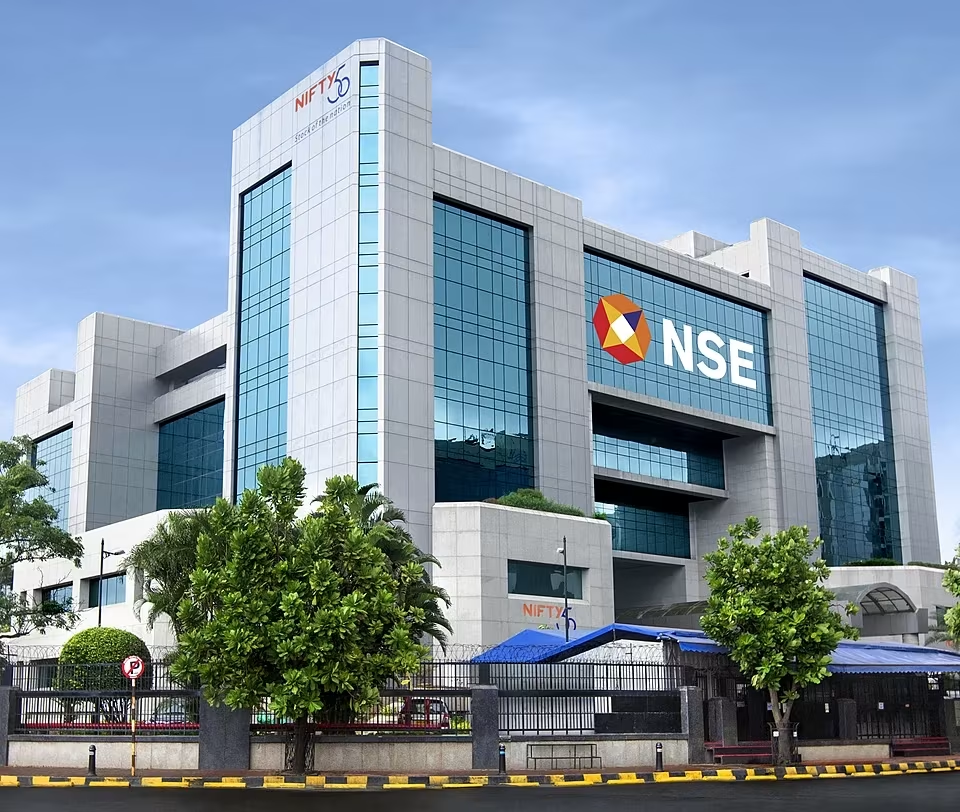
NSE India. Photo: Wikipedia
Patna: The National Stock Exchange of India (NSE) opened its initial public offering (IPO) for subscription on September 17, 2026, at a price band of Rs 1,700 to Rs 1,785 per share, valuing the exchange at approximately Rs 4.42 lakh crore at the upper end . The three-day issue, entirely an offer for sale of 12.64 crore shares by existing shareholders, will close on September 21 and aims to raise up to Rs 22,561 crore .
At the upper price band, NSE trades at roughly 42.9 times its FY2026 earnings, making it one of the most richly valued exchange operators globally . The valuation has drawn scrutiny from institutional investors during roadshows in Hong Kong, London, and New York, where concerns about the exchange’s heavy reliance on derivatives trading and regulatory pressures prompted NSE to reduce its initial valuation target by approximately 15 percent from an earlier ambition of around $55 billion .
More than 120 global funds, including BlackRock and GQG Partners, participated in the investor meetings . While interest in the listing remains significant, enthusiasm has moderated as questions over future growth have become more prominent.
John Ninia, a partner at Mobius Investments, said the exchange appears expensive relative to global peers over the short to medium term. ‘As a long-term investor, we would find the risk/reward more attractive following a valuation reset,’ Ninia said .
Valuation Comparison With Global Peers
NSE’s 42.9x price-to-earnings multiple exceeds that of most major listed exchange operators. Coinbase Global trades at approximately 40.35x earnings, while Singapore Exchange commands 34.56x . The London Stock Exchange Group trades at 29.35x, and Nasdaq at 25.95x . The CME Group, Intercontinental Exchange, Hong Kong Exchanges, Deutsche Börse, Cboe Global Markets, and Japan Exchange Group trade broadly in the 23x to 25x range .
Domestically, however, NSE’s valuation sits below that of its listed peers. BSE Ltd trades at 54.33x earnings, and MCX trades at 60.77x . Analysts note that BSE’s higher multiple reflects faster current growth off a smaller base.
Rajesh Agarwal, head of research at AUM Capital Market, said NSE’s premium is defensible. ‘NSE’s IPO is priced at a premium, but its dominant market position, structural growth opportunities, and operational strength make the valuation defensible,’ Agarwal said .
Market Dominance and Financial Performance
NSE has maintained its position as India’s largest stock exchange by total turnover in cash equities and equity derivatives from fiscal 2001 through fiscal 2026 . In fiscal 2026, NSE accounted for 92.99 percent of India’s cash-market turnover, 99.79 percent of equity futures, and 74.71 percent of equity options based on premium turnover .
The exchange reported total income of Rs 18,713 crore in fiscal 2026, with a profit after tax of approximately Rs 10,071 crore . Profitability metrics place NSE among the most profitable global exchange operators, with a 62.1 percent profit margin and 32.1 percent return on equity in fiscal 2026 .
However, fiscal 2026 revenue declined 3.1 percent year-on-year to Rs 16,601 crore, and net profit fell 12.2 percent to Rs 10,071 crore . The decline reflects regulatory measures targeting retail options trading volumes and increased competition from BSE in the derivatives segment .
Nikhil Khandelwal, chairman and managing director of Systematix Group, said the valuation appears fair given the exchange’s earnings profile and market dominance. ‘At Rs 1,785, NSE is valued at around Rs 4.4 lakh crore, translating into roughly 41 times its FY26 earnings,’ Khandelwal said .
Derivatives Dependence and Regulatory Risks
Analysts have flagged NSE’s dependence on derivatives transaction fees as a key risk. Options transaction fees contribute significantly to revenue, and regulatory measures aimed at curbing retail speculation in futures and options have weighed on trading volumes .
Ashutosh Tiwari, managing director and chief investment officer for public markets at Equirus, said earnings at both NSE and BSE should grow once current regulatory measures on options trading normalize. ‘When things normalise and start to grow back again, it will again be a growth story in my opinion,’ Tiwari said .
SEBI’s measures targeting retail options volumes were introduced after concerns that most retail traders lose money on these trades . Tiwari expects volumes to recover within a few months as recent regulatory clarifications take effect, and does not see a structural decline in exchange volumes .
Grey Market Premium Declines Ahead of Listing
The grey market premium for NSE shares declined steadily in the days leading up to the IPO opening, falling from Rs 310 per share on September 5 to Rs 125 per share on September 17 . At the current premium, NSE shares are estimated to list at approximately Rs 1,910, implying a gain of about 7 percent over the upper price band .
The GMP decline suggests moderating enthusiasm in the unofficial market. The premium had ranged between Rs 145 and Rs 310 over the 13 trading sessions prior to the issue opening .
Ratish Gupta, director at Wealth Wisdom India, cautioned against assuming strong IPO demand will translate into listing gains. ‘Investors should also remember that several recent large IPOs, including Hyundai, LIC, Paytm and Tata Capital, listed flat or below their issue prices, highlighting the risk of chasing IPOs purely for listing gains,’ Gupta said .
Brokerage Recommendations
Several domestic brokerages have issued subscribe ratings on the IPO. SAMCO Securities recommended subscribing for the long term, citing NSE’s leadership, financial strength, high margins, debt-free balance sheet, and structural capital-market growth .
Choice Broking said the price buys market infrastructure with no real substitute. ‘What that price buys is market infrastructure with no real substitute,’ the brokerage said, adding that the main concern is index options where NSE has lost share since SEBI allowed each exchange only one weekly expiry day .
Ventura noted that NSE held 92.99 percent share in cash-market turnover and 99.79 percent in equity-futures turnover in fiscal 2026, underscoring the depth of its liquidity franchise .
The anchor investor portion of the IPO raised Rs 6,746 crore from institutional investors, including Life Insurance Corporation of India and global funds . LIC, which holds a 10.72 percent stake in NSE, is not participating in the offer for sale and will retain its entire holding .
NSE shares are expected to list on the BSE on September 24, 2026 .
About the Author