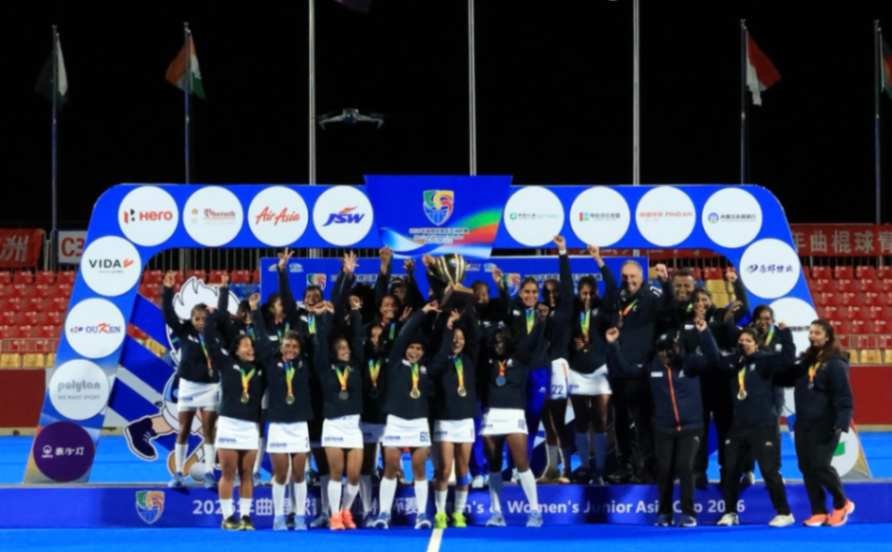
Lausanne Switzerland: Ten days of junior Asian hockey came to an electrifying conclusion at the Moqi Training Base in China, with India sweeping both the men’s and women’s trophies at the Junior Hockey Asia Cup 2026. Beyond continental silverware, the tournament served as the premier qualification pathway for the upcoming FIH Junior Hockey World Cup 2027, determining the Asian contingents heading to the global showcase.
Women’s Tournament: India Retain Crown; Top Four Seal World Cup Spots
The women’s edition adopted a high-stakes format divided into the Challenger and Elite Pools, with only the top four nations securing qualification for the FIH Junior Hockey Women’s World Cup 2027.
Reigning champions India extended their reign over the continent, capturing a historic third consecutive title. After storming past South Korea 5-1 in the semi-finals, the Indian side faced hosts China in a tense final. In a closely contested match of tactical precision, Sanika Chandrakant Mane’s 17th-minute strike made the difference, sealing a dramatic 1-0 win for India. Mane finished as the tournament’s joint top-scorer (7 goals) alongside Bangladesh’s rising star Sharika Rimon.
Host nation China, propelled by tournament Best Player Wei Qixiao, made a formidable run to the final, highlighted by an emphatic 6–0 win over Japan in the semi-finals, to comfortably claim silver and their place on the world stage.
In the third-place encounter, Japan delivered a disciplined 2-0 victory over Korea, earning the bronze medal courtesy of goals from Renka Tetsuka and Momoka Suzuki. Consequently, semi-finalists India, China, Japan, and South Korea locked up the four Asian qualification quota places for the FIH Junior Hockey Women’s World Cup 2027.
Men’s Tournament: India Clinch Sixth Title; Top Six Book World Cup Berths
With six qualification spots on the line for the FIH Junior Hockey Men’s World Cup 2027, the stakes could not have been higher across the competition.
Defending champions India reinforced their historic dominance at the junior continental level by securing a record sixth continental crown. Led by prolific captain and tournament top-scorer Anmol Ekka, who netted an astonishing 17 goals across the campaign, India advanced through the knockout rounds with an authoritative 3-1 semi-final win over Malaysia.
Waiting for them in the gold-medal encounter was South Korea, who produced one of the tournament’s hallmark storylines. To reach their first Junior Asia Cup final in 18 years (since 2008), the Koreans delivered an inspired 4-1 semi-final triumph over Pakistan. However, India proved too formidable in the final, closing out a decisive 4-1 victory to retain their Asian title.
In the bronze-medal playoff, Pakistan bounced back to overcome Malaysia 4-2, rounding out the podium finishers. Meanwhile, the classification round determined the final two World Cup tickets: Japan secured fifth place with a 3-1 win over host nation China. By virtue of finishing inside the top six, India, South Korea, Pakistan, Malaysia, Japan, and China officially punched their tickets to the FIH Junior Hockey Men’s World Cup 2027.
Moqi provided a brilliant showcase of world-class junior hockey, demonstrating the fast pace and technical growth across Asian junior programmes. For the ten qualified squads — six men’s and four women’s, the journey now turns to the global stage — where they will take on the world’s best at the FIH Junior Hockey World Cup 2027.
About the Author