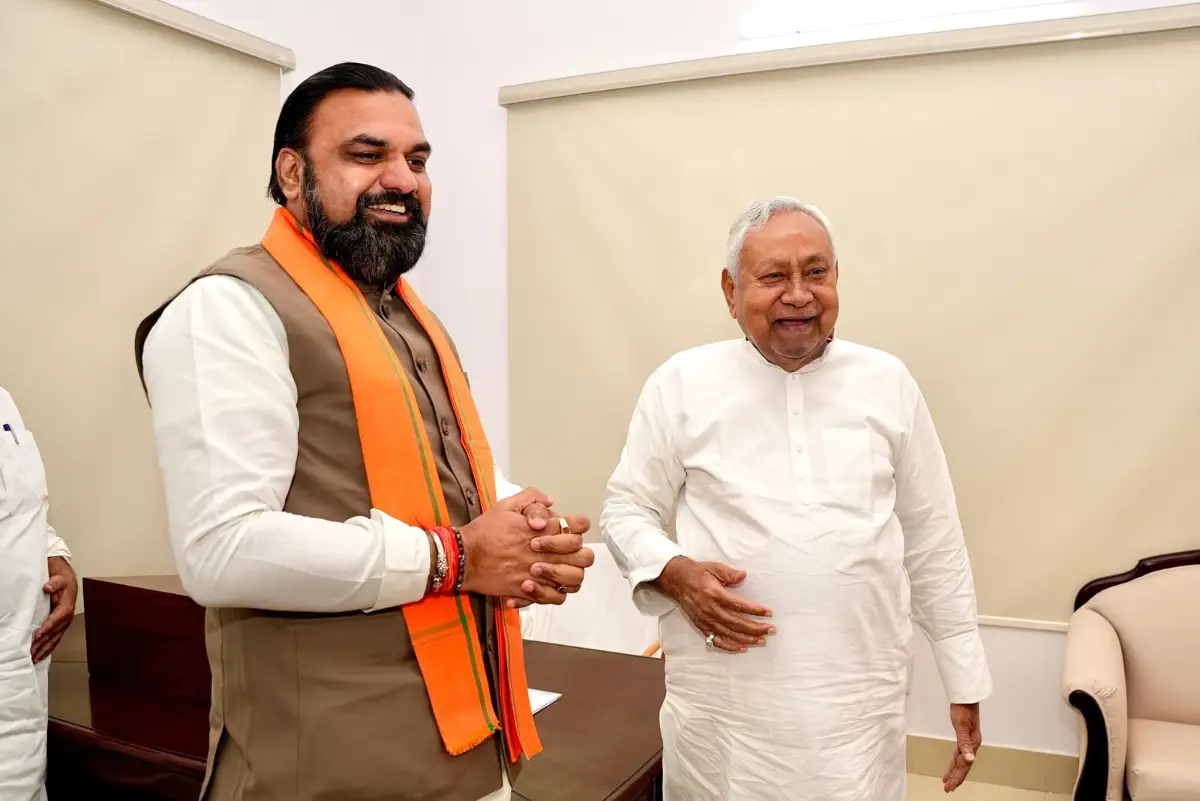
Bihar Chief Minister Samrat Choudhary with JD(U) chief Nitish Kumar. Photo: Aftab Alam Siddiqui
By Neeraj Kumar
Patna: Voting for 10 seats of the Bihar Legislative Council will be held on June 18. Of these, nine seats are scheduled for regular elections for a six-year term, while one seat will be filled through a by-election.
The by-election has been necessitated by the resignation of former Chief Minister and current Rajya Sabha MP Nitish Kumar from the Council. Around four years of the term for this seat still remain.
All 10 seats fall under the Assembly quota, meaning that members of the Bihar Legislative Assembly (MLAs), rather than the general public, will cast their votes. The nomination process began on June 1.
Among the nine seats going for regular elections are those currently held by JD(U) leaders Shribhagwan Singh Kushwaha, Ghulam Gaus, Bhishma Sahni and Kumud Verma. BJP leaders Samrat Choudhary and Sanjay Mayukh are also completing their terms. Additionally, seats held by RJD’s Sunil Kumar Singh and Mohammad Farooq, along with Congress leader Sameer Kumar Singh, are up for election.
In the 243-member Bihar Assembly, the winning quota for the nine seats is calculated based on the total number of MLAs voting. If all 243 members cast their votes, the total vote value is considered to be 24,300, as each MLA’s vote carries a value of 100.
This total is divided by 10 (one more than the number of seats), resulting in 2,430. Adding one gives a winning quota of 2,431. In simple terms, a candidate needs first-preference votes from around 25 MLAs to secure victory.
At present, the NDA holds 202 MLAs in the Assembly, including members from JD(U), BJP, LJP (Ram Vilas), HAM, and RLM. Based on this strength, the alliance is comfortably positioned to win eight seats.
On the other hand, the Mahagathbandhan — comprising RJD, Congress, CPI(ML), CPM and other allies — has over 35 MLAs. With additional support from AIMIM and BSP legislators, the opposition bloc’s strength stands at around 41, which is sufficient to win one seat.
If all seats are not decided based on first-preference votes, second-preference votes will be counted. This method has played a decisive role in previous Rajya Sabha elections, including the victory of BJP candidate Shivesh Ram, who benefited from transferred surplus votes after several candidates won in the initial rounds.
Current arithmetic suggests that the NDA is set to secure eight of the nine regular seats, while the Mahagathbandhan is likely to win one. After securing eight seats, the NDA would have only two surplus votes, whereas the opposition would have around 16 extra votes — insufficient for an additional seat.
However, the contest could become interesting if any party fields a tenth candidate strategically or if cross-voting occurs.
Overall, the present political and numerical scenario clearly indicates that the NDA is likely to win eight seats and the Mahagathbandhan one seat. The final outcome, however, will only be confirmed after voting and the counting of preference votes.
About the Author