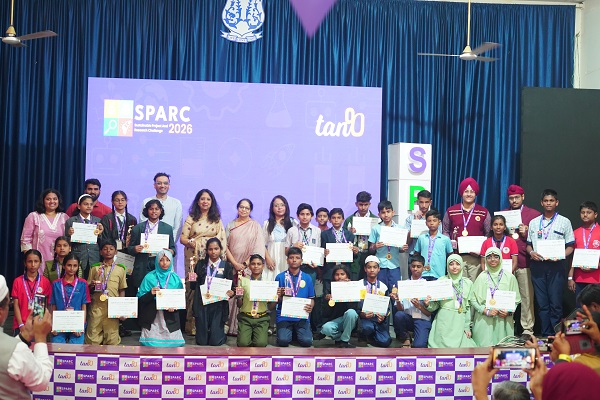
Winners of the SPARC 2026 national-level competition along with Chief Guest Kumari Shibulal at the grand finale held in Bengaluru on February 1st
Bengaluru: Student-built innovations tackling everyday challenges in health, safety, sustainability and clean energy were showcased and recognised at SPARC 2026, a national-level student innovation finale curated by Tan90 Education and held in Bengaluru on Sunday, February 1.
Top honours went to Siri MS of Vagdevi Vilas School, Bidadi (Mysore Road), Karnataka, for developing an eco-friendly sanitary pad made from natural absorbent materials, and Shardul Prakash Deshinge of VK Mate High School, Chinchwad, Pune, for designing a safety-focused pressure cooker aimed at preventing cooking-related accidents. Their projects stood out for their strong focus on practicality and human-centred design.
Over the past five months, SPARC (Student Project and Research Challenge) 2026 engaged more than 1,000 middle and high school students from 185 schools across 30 cities in 13 states. From this nationwide pool, 36 finalists were selected to present their innovations at the Bengaluru finale. The 2026 edition marked SPARC’s evolution from a city-led initiative into a pan-India student innovation movement, bringing together learners from diverse educational and socio-economic backgrounds.
The event was inaugurated by Kumari Shibulal, Founder and Chairperson of Shibulal Family Philanthropic Initiatives (SFPI). Expressing her optimism, she said the national scale of SPARC reflected a shift towards hands-on, curiosity-driven learning and hoped the platform would grow into a lasting culture that values imagination, effort and persistence.
Other awardees included Hartej Singh Sall of DAV Public School, Ludhiana, for ClogBuster; Pilla Naga Chaintanya of Sri Rama Sainik School, Vijayawada, for Seesaw Power Generator; Basavaraj Chalageri of Mount Everest High School, Byatarayanapura, for PloughPro; and Sayyed Nuzaifa Irshad Ali of Ideal English School, Malad, Mumbai, for an Algae-Based Oxygen Generator.
Projects were assessed by a multidisciplinary jury comprising educators, development sector leaders and social innovators, including representatives from Azim Premji University, Labournet Foundation, United Way Bengaluru and other organisations.
The innovations were developed around four core themes—Sustainable Cities and Mobility; Health and Wellbeing for All; Clean Energy and Climate Action; and Inclusive Growth and Social Equity—highlighting safety, affordability, environmental responsibility and real-world applicability.
The finale also featured an Experience Zone offering hands-on activities across carpentry, art, mechanical concepts, mathematics, electrical systems and innovation labs, along with a student-led skit on classroom learning transformation and a panel discussion on STEM education.
About the Author