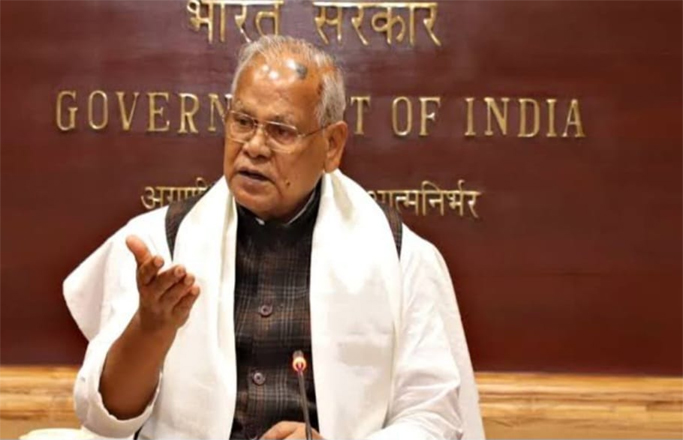
Union Minister Jitan Ram Manjhi
From Neeraj Kumar
Patna: Prohibition emerged as a major issue in the 2025 Bihar Assembly elections. Political strategist Prashant Kishor had openly declared that if a Jan Suraaj government came to power, the prohibition law would be scrapped within an hour. The electorate, however, rejected Jan Suraaj, resulting in a crushing defeat for the outfit in Bihar.
The state has been under prohibition since April 5, 2016. Although the law has undergone several amendments over the years, complete enforcement has remained elusive. Liquor smuggling continues unabated, while a series of deaths caused by spurious liquor has kept the policy under constant scrutiny.
Questions over prohibition have been raised not only by the Opposition but also by leaders within the ruling alliance. Jitan Ram Manjhi, leader of the NDA ally HAM and a former chief minister, has been among the most vocal critics. He has repeatedly spoken against the law and demanded a review. On one occasion, Manjhi even claimed that “we drink liquor behind closed doors at night,” though he later retracted the statement.
Now a Union minister, Manjhi has once again expressed concern over the prohibition law, calling for a review. He has said that those jailed across various districts merely for consuming liquor should be released.
Manjhi has also pointed out that the third amendment to the law came after he raised his voice, alleging that big smugglers escape punishment due to their financial clout. He recalled that Chief Minister Nitish Kumar had once said there was no need to arrest someone merely for consuming liquor or carrying up to 250 grams.
According to Manjhi, officials of the police and excise departments often let liquor smugglers go while sending the poor to jail. He claimed that nearly six lakh cases have been registered against poor people and argued that enforcement should not disproportionately affect the underprivileged. “If possible, cases registered against the poor should be withdrawn,” he said.
Bihar’s new excise policy was introduced on December 21, 2015, followed by the announcement of prohibition on March 1, 2016. The law came into force on April 1, 2016, and full prohibition was implemented from April 5 that year.
Between 2016 and 2023, more than 6.61 lakh cases were registered under the prohibition law, leading to the arrest of over nine lakh people. More than 75,000 vehicles were auctioned, generating revenue of about ₹428.5 crore for the government.
According to the Prohibition and Excise Department, over 16 lakh litres of illicit liquor were seized between January and June 2025, including eight lakh litres of foreign liquor. The total value of the seized liquor is estimated at around ₹75 crore. Enforcement drives have continued since then.
Since the introduction of prohibition, action has been taken against both smugglers and consumers. A total of 6,40,379 people have been convicted so far, with 6,38,000 cases related solely to liquor consumption. Courts have awarded death sentences to nine people, life imprisonment to 18, and prison terms exceeding 10 years to several others.
While Manjhi has consistently raised his voice in support of the poor, his son Santosh Suman, a minister in the Bihar government, has distanced himself from his father’s views. Santosh Suman has maintained that the prohibition law should be implemented strictly, asserting that it serves the interests of the poor. “The law applies equally to everyone, rich or poor. If anyone is falsely implicated, we will stand by them, but violations must be dealt with firmly,” he said, dismissing Manjhi’s remarks as exceptional rather than the norm.
Political analyst Dr Sanjay Kumar notes that different parties in Bihar hold divergent views on prohibition and have repeatedly questioned its success. He adds that Manjhi’s concern is rooted in the reality that a large number of Dalits are lodged in jails in prohibition-related cases.
While Manjhi continues to speak candidly on the issue, his stance has been publicly rejected by his own son, who appears firmly aligned with Chief Minister Nitish Kumar and opposed to any review or amendment of the law.
Prohibition has produced mixed results in the state. On the positive side, incidents of domestic violence have declined significantly. According to NCRB data, around 15,000 cases were reported in 2015, before prohibition. The number fell to about 9,000 in 2020 and further declined to nearly 7,500 in 2024.
On the flip side, the unavailability of legal liquor has driven people towards illicit brews, leading to several deaths. NCRB figures indicate that more than 400 people have died since 2016 due to consumption of spurious liquor, though experts believe the actual toll may be higher.
As per official data, 156 deaths were reported in 2016, nine in 2018, 90 in 2021, 100 in 2022, 35 in 2023, and around 25 in 2024.
The most notorious incident was the Bhagalpur hooch tragedy of 2022, when over 70 people died after consuming toxic liquor during the Holi festival. Several others lost their eyesight. In 2024, similar incidents in Siwan and Chhapra claimed more than 60 lives combined, with additional cases reported from Gopalganj and other districts, triggering widespread political outrage.
About the Author