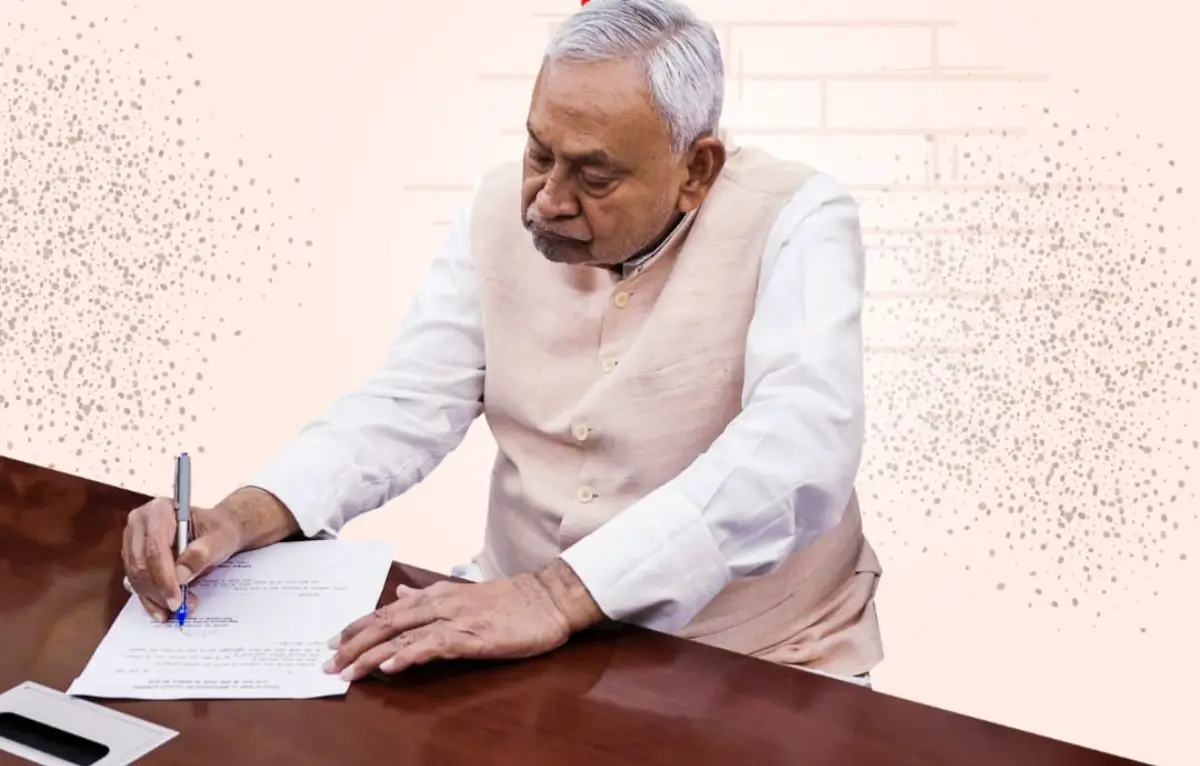
Bihar Chief Minister Nitish Kumar
By Neeraj Kumar
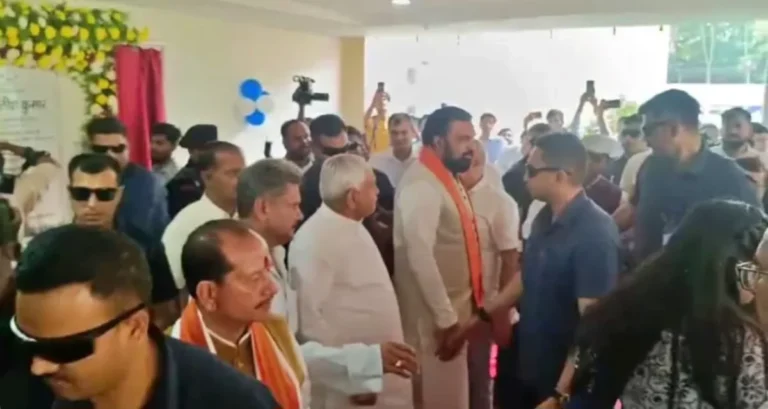
Patna: On March 5, 2026, the political atmosphere in Patna was defined not by the usual clamor of upheaval, but by a calculated, almost somber closure. In the presence of Union Home Minister Amit Shah—a visual personification of the Bharatiya Janata Party’s ascending hegemony. Nitish Kumar filed his nomination papers for the Rajya Sabha. This was more than a mere shift in designation; it was the moment the “Architect of Modern Bihar” chose to relinquish the state’s executive mantle to fulfill a personal legislative arc, signaling the twilight of a two-decade era that defined the heart of the Hindi belt.
For a leader who has taken the oath of Chief Minister a record ten times, the decision to vacate the “throne” just months into his final term has sparked intense deliberation. Is this a strategic retreat to a Margdarshak (mentor) role, a dignified exit necessitated by a perceived fragile mental state, or the final fulfillment of a career-long ambition?
1. The Rare “Four Houses” Milestone
Entering the Rajya Sabha is not a lateral move for Kumar; it is the completion of a rare “Grand Slam” in Indian governance. By securing a seat in the Upper House of Parliament, Kumar joins an incredibly exclusive circle of Bihar leaders who have served in all four legislative bodies: the Lok Sabha, the Rajya Sabha, the Bihar Legislative Assembly, and the Bihar Legislative Council.
In the high-stakes history of the state, only four other men have occupied seats in all four houses:
- Lalu Prasad Yadav (The RJD patriarch and Kumar’s perennial rival)
- Upendra Kushwaha (Rashtriya Lok Morcha leader)
- Nagmani (Former Union Minister)
- Sushil Kumar Modi (The late BJP stalwart and long-time Deputy CM)
For Kumar, this transition is the culmination of a personal aspiration that predated his executive dominance.
“Having served as a member of both the Bihar Legislative Assembly and the Legislative Council, I had always hoped to have the rare distinction of also being a member of both Houses of Parliament… I am fulfilling that dream now by seeking a Rajya Sabha term.”
2. The Master of the “Somersault” and the 10-Term Paradox
The central paradox of Nitish Kumar’s legacy lies in his “ideological promiscuity.” Labeled “Paltu Ram” by critics for his legendary U-turns between the BJP and the RJD, Kumar transformed political inconsistency into a high-art form of self-preservation. Since 2005, he has remained the indispensable pivot of Bihar’s power dynamics.
Despite the “somersaults,” his longevity is unmatched in Indian statecraft. By taking the oath as Chief Minister ten times, he proved that in the volatile laboratory of Bihar politics, the “middle path”—no matter how frequently it shifted—was the only one that led to the secretariat. He remained a king who made kings, ensuring that the road to Patna always required his clearance.
3. The “Sushasan Babu” Legacy: Growth vs. Rock Bottom
Kumar meticulously cultivated the image of “Sushasan Babu” (the man of good governance), a leader who ostensibly replaced “Jungle Raj” with a bureaucratic machinery that delivered:
- Social Engineering: Implementing 50% reservation for women and backward castes in local body elections, creating a loyal, gender-based vote bank.
- Infrastructural Revival: Expanding road networks and the iconic bicycle scheme for schoolgirls, which fundamentally altered rural social mobility.
- State Discipline: Strengthening the Arms Act and establishing fast-track courts to neutralize the political-criminal nexus of the 1990s.
However, a glaring synthesis of data reveals a troubling reality. Under Kumar, Bihar achieved a phenomenal 14% growth rate—the second-highest in India. Yet, the state remains at the “rock bottom” of human development indicators. The “bureaucratic ecosystem” he built—one so powerful that BJP leaders recently complained to Amit Shah that “bureaucrats were running Bihar”—succeeded in building roads but failed to move the needle on structural poverty, leaving behind a state that has grown economically but remained socially stagnant.
4. A New Era: The Saffron Shift in Patna
The presence of Amit Shah during the March 5 nomination was no coincidence; it marked the formalization of the “Saffron Shift.” The 2025 election results (where the BJP secured 89 seats to the JD(U)’s 85) effectively stripped Kumar of his “Big Brother” status within the NDA.
The clues to his loosening grip were evident long before the nomination:
- Portfolio Erosion: For the first time, Kumar was forced to relinquish the “Home” portfolio, the traditional nerve center of his authority.
- Institutional Loss: The JD(U) was compelled to cede the Assembly Speaker post to the BJP.
- The Power Vacuum: With Kumar moving to Delhi, the BJP is poised to appoint its first-ever Chief Minister in Bihar, ending decades of regional-party dominance.
5. The “Engineer” and the Activist: A Return to Roots?
Tracing the human legacy of the man reveals a journey from an electrical engineering student at Bihar Engineering College to a revolutionary forged in the Jayaprakash Narayan (JP) movement. His credentials as a socialist were cemented by a nine-month imprisonment during the 1976 Emergency—a detail that underscores his lifelong opposition to dynastic centralism.
Yet, this final act carries a whiff of the very dynastic politics he once criticized. As he moves to the Rajya Sabha, his son, Nishant Kumar, is expected to fill the Legislative Council seat his father vacated. This “debut” challenges Nitish’s claim to be a “non-dynast,” a primary distinction he used against Lalu Prasad Yadav. Furthermore, internal friction looms as the JD(U) “old guard,” led by figures like Lalan Singh and Sanjay Jha, must now navigate a party where the central brand—Nitish himself—is no longer present to mediate their rivalries.
About the Author