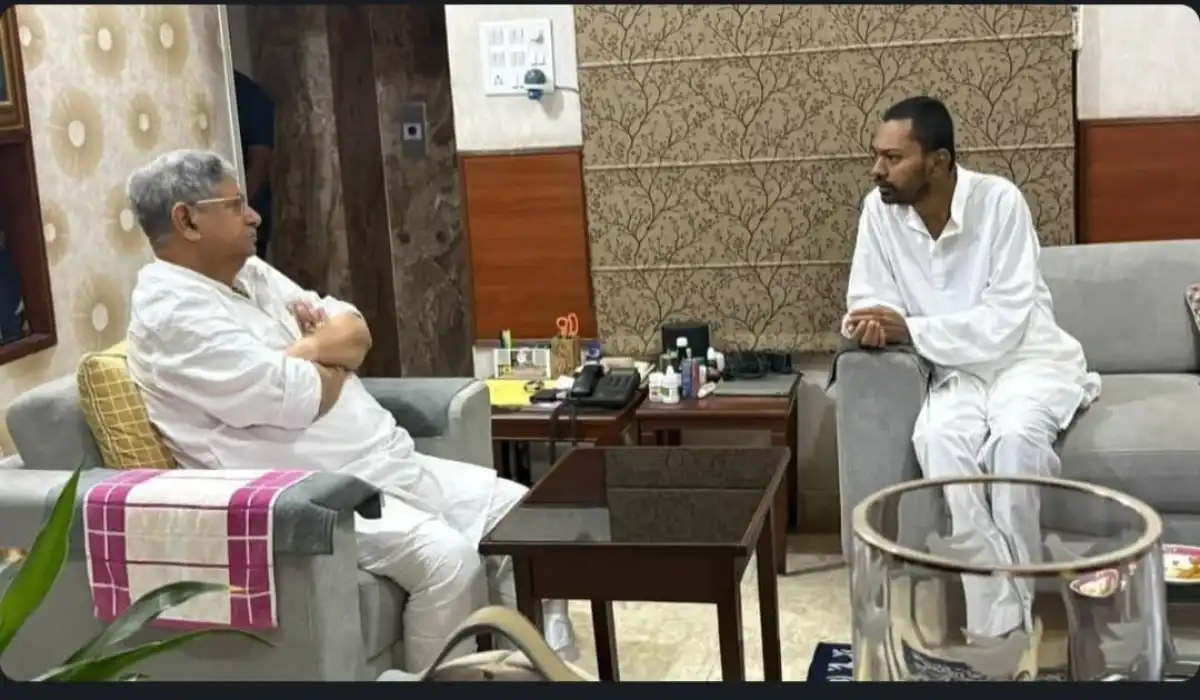
Union Minister Lalan Singh and Nishant Kumar. Photo: Neeraj Kumar
By Neeraj Kumar
Patna: For years, Nishant Kumar was the quiet center of Bihar’s loudest political conversations—a son who preferred the periphery while his father, Chief Minister Nitish Kumar, defined the state’s destiny. That era of reclusion ended abruptly on March 8. Stepping out from the long shadows of 1 Aney Marg, Nishant’s formal induction into the Janata Dal (United) was not merely a ceremony; it was a tectonic shift. In a mere twelve days of “active mode,” he has transformed from a private citizen into a political vanguard, signaling a calculated recalibration of the JD(U) DNA.
Is this the simple emergence of a successor, or a sophisticated maneuver to insulate the party’s future? Here are five key takeaways from Nishant Kumar’s high-velocity entry into the political fray.
1. The Living Archive: Downloading Forty Years of Strategy
Nishant’s early itinerary suggests a hunger for institutional memory rather than just optics. His closed-door huddle with Union Minister Lalan Singh—a meeting described by insiders as “secret”—was a strategic download of four decades of political data. Lalan Singh is more than a veteran; he is a living archive of the movement’s leanest years.
“Lalan Singh and Nitish Kumar share a bond spanning more than four decades. Having served as both State and National President, Singh was by Nitish Kumar’s side when he was first struggling to establish his political footprint in Bihar.”
By seeking “tips” from a man who was present before the JD(U) was a behemoth, Nishant is bypassing the standard learning curve. This mentorship signals that Nishant isn’t just inheriting a throne; he is being schooled in the “struggle-era” grit required to sustain it.
2. The Bhumihar Bridge: Tactical Reconciliation in Ghosi
Perhaps the most astute move in Nishant’s 12-day sprint was his visit to the residence of Arun Kumar. Historically, the relationship between Nitish Kumar and Arun Kumar was fractured by years of friction. While Arun Kumar recently returned to the fold—evidenced by his son Rituraj’s victory in the Ghosi assembly seat—the wounds of past battles often linger.
For a political analyst, this outreach is a clear signal of maturity. By engaging with his father’s former rivals, Nishant is acting as a diplomatic lubricant for the party’s machinery. More specifically, this is a calculated attempt to secure the Bhumihar vote—a critical demographic for the JD(U)’s survival. By personally seeking tips from Arun Kumar, Nishant is positioning himself as a bridge-builder capable of coalescing disparate factions before the next electoral cycle.
3. The 12-Day Sprint: Sanjay Jha and the New Guard
The formalization of Nishant’s role was handled with significant weight. It was National Working President Sanjay Jha who administered the membership in the presence of the party’s senior hierarchy, lending the induction the “official blessing” of the JD(U) top brass.
Since that moment, Nishant has catalyzed the formation of a “Team Nishant”—a cohort of young JD(U) MLAs who represent a generational shift. This “youth team” recently accompanied him to Kalyan Bigha, signaling their loyalty to his burgeoning leadership. This is not merely cosmetic; within party circles, it is understood that this vanguard will be rewarded with significant opportunities and government roles when the next administration is formed. Nishant is not just joining a party; he is building a loyal power base from the ground up.
4. Establishing Independent Ground: The Bihar Yatra and the Secular Brand
Nishant is already pivoting toward the grassroots with the blueprint for an upcoming state-wide “Bihar Yatra.” His preparation is methodical, involving constant feedback sessions with current legislators to understand local grievances.
Crucially, his recent visibility at Iftar parties—both at the party headquarters and the Chief Minister’s residence—serves a deeper purpose. While Nitish Kumar has long held the “Sushasan Babu” image, Nishant is using these platforms to establish his own secular credentials. By networking directly with Muslim leaders and the cadre, he is carving out an identity independent of his father’s shadow, ensuring the party’s “inclusive” branding remains intact under new leadership.
5. Continuity as Command: The 20-Year Mandate
Despite the modern energy he brings, Nishant is careful to frame his mission through the lens of legacy. He has articulated a clear mandate that honors his father’s two-decade tenure while pivoting toward organizational strength.
“My father has worked for 20 years; I will take that work forward and strengthen the party in Bihar.”
This statement serves a dual purpose: it reassures the traditional base that the core mission remains unchanged, while the emphasis on “strengthening the party” gives Nishant the personal mandate to implement the structural changes necessary for the JD(U)’s survival in a shifting landscape.
About the Author