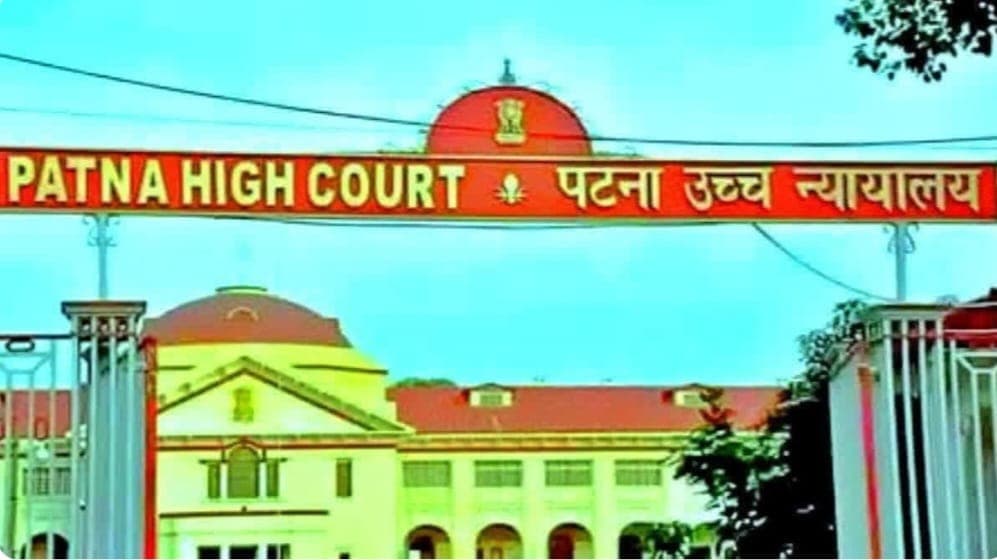
Patna High Court
By Alok Mohit
Patna: The Patna High Court has dismissed a petition filed by a former Bihar police constable challenging his dismissal from service.
Justice Partha Sarthy, while hearing the petition related to a disciplinary dispute dating back nearly two decades, upheld the dismissal order, ruling that no case for judicial interference was made out. The order was uploaded on December 12,2025.
Petitioner Anant Kumar Singh, a resident of Munger district, had moved the high court against the dismissal order issued on June 10, 2006, challenging the rejection of his departmental appeal by the then DIG in December 2006 and the dismissal of his memorial by the then DGP in May 2013.
Singh was appointed as a constable pursuant to an advertisement issued in 1998. According to police authorities, discrepancies were noticed between the photograph and signature submitted by Singh during recruitment and his actual photograph and signature. He was repeatedly directed through official communications in August 2001 to appear in person for physical verification and comparison of records. However, the petitioner failed to comply with these directions, leading to his suspension on September 17, 2001.
A chargesheet was subsequently issued on May 16, 2002, alleging gross indiscipline and defiance of lawful orders. Singh submitted his reply, following which a departmental inquiry was conducted. The inquiry officer concluded that the charges had been proved. Acting on the inquiry report, the then Senior Superintendent of Police (SSP), Patna, dismissed Singh from service in 2006, while limiting his suspension period benefits to subsistence allowance alone.
Singh’s departmental appeal was rejected by the then DIG, Patna later that year. After being acquitted in a related criminal case in January 2013, Singh approached the police authorities once again. His memorial was, however, rejected by the then DGP on the ground of being time-barred.
Singh, in his petition, argued that the charges in the criminal case and departmental proceedings were identical and based on the same witnesses. Since the prosecution witnesses failed to support the case in the criminal trial, leading to his acquittal, the departmental findings could not stand, he contended. He also claimed that his failure to appear for verification was due to his wife’s illness, for which he had taken leave, and alleged violation of principles of natural justice.
The State opposed the plea, arguing that the standards of proof in criminal and departmental proceedings are fundamentally different. Relying on Supreme Court judgments, the State contended that an acquittal in a criminal case did not automatically invalidate departmental punishment, especially when the acquittal was not “honourable.”
The court accepted the State’s submissions, observing that while criminal cases required proof beyond a reasonable doubt, departmental proceedings were decided on the basis of preponderance of probabilities. The judgment noted that Singh had been given multiple opportunities during the inquiry and had even appeared on certain dates but failed to present any substantive defence. The inquiry officer, after examining the records, photographs, and signatures, found the charges to be correct.
Justice Partha Sarthy also took serious note of the delay in pursuing remedies. He said Singh approached the then DGP with a memorial nearly seven years after his dismissal and rejection of the appeal. Citing a Supreme Court ruling, the high court held that belated memorials could not revive a “dead cause of action” and that writ courts should not entertain stale claims marked by delay and laches.
Finding no procedural irregularity or violation of natural justice, the court concluded that the petitioner had failed to establish any legal ground for interference and rejected the petition.
About the Author