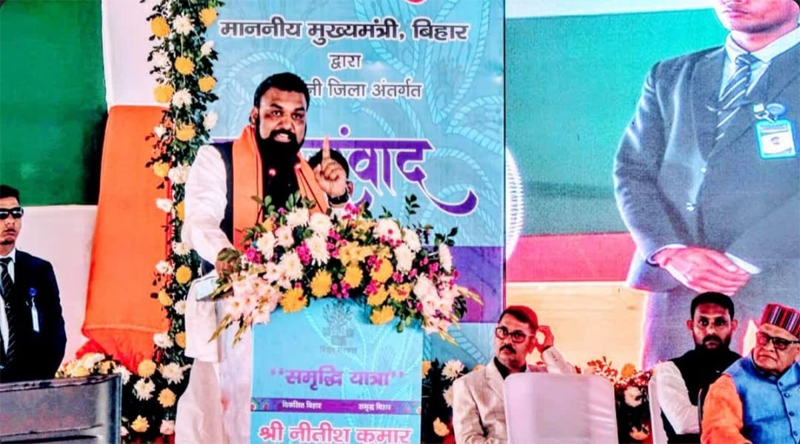
Bihar Deputy Chief Minister Samrat Choudhary
By Neeraj Kumar
Patna: Bihar Deputy Chief Minister and Home Minister Samrat Choudhary said that before 2005, villages in the state did not receive even five hours of electricity, whereas today round-the-clock power supply has become a reality.
He said the state government is providing free electricity up to 125 units per month, resulting in zero power bills for nearly 1.70 crore households out of the state’s total 1.90 crore families.
125 Units of Free Power
Ahead of the Bihar Assembly elections, the Nitish Kumar-led government had announced free electricity up to 125 units per month, a move described as a “masterstroke”. The government has since been highlighting this decision on various platforms. During the ongoing Samriddhi Yatra, Choudhary outlined several achievements of the NDA government.
He said the Jeevika scheme has brought a major transformation in the lives of women. Around 1.56 crore women have received ₹10,000 each directly into their bank accounts, and financial assistance of up to ₹2 lakh will be provided to help them take up employment and self-employment.
Focus Shifts to Employment and Industry
The Deputy Chief Minister said that after laying a strong foundation in health, education, roads, electricity and drinking water, the government’s focus has now shifted towards employment and industrial development.
Efforts are underway to revive Bihar’s industrial legacy. Policies related to semiconductors, industrial corridors, defence corridors and the IT sector are being implemented so that youths can find employment within the state itself. “In the next five years, we aim to create a wide industrial network and ensure jobs for people in Bihar,” he said.
Kosi River: From Curse to Boon
Choudhary said the Kosi river, once considered a curse for Bihar, has now turned into a blessing for the state. Under the leadership of Chief Minister Nitish Kumar, the NDA government has carried out effective river management, transforming it into a lifeline.
He recalled that in 2007–08, after 1.92 lakh cusecs of water were released from Nepal, devastating floods hit Supaul, Madhepura, Saharsa, Khagaria and several other districts in the Kosi region. “The situation was terrifying at that time,” he said.
However, he added that the NDA government adopted a planned strategy to control the Kosi and use it as a tool for development.
Today, nearly four lakh acres of land are being irrigated through the river. The Kosi–Mechi link project has been launched, embankments are being raised, and regular repairs are being carried out. In 2024, despite the release of 6.48 lakh cusecs of water from Nepal, the impact was limited to only around 150 villages.
“This change is proof of good governance and better management,” Choudhary said, adding that the Kosi, once described as a curse in textbooks, has now earned recognition—so much so that a building in the MPs’ residential complex in Delhi has been named ‘Koshi’.
About the Author