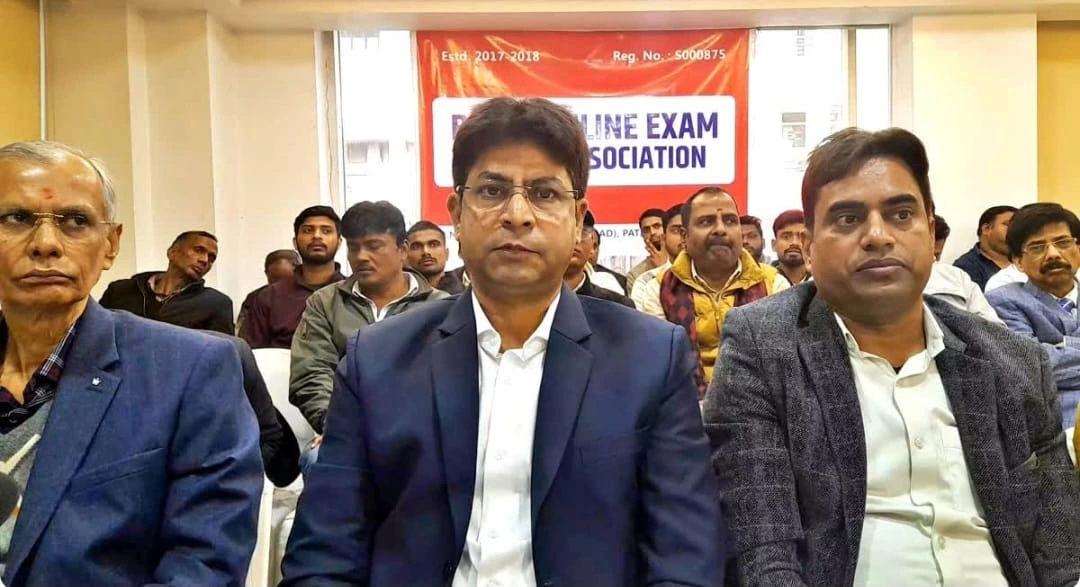
Office bearers of Bihar Online Centre Association. Photo: Neeraj Kumar
By Neeraj Kumar
Patna: The Bihar Online Centre Association has raised serious objections to the Bihar government’s current examination policy, warning that it threatens the very survival of private online examination centres across the state.
Addressing a press conference in Patna on Tuesday, Association president Kanhaiya Singh said the policy has pushed nearly 250 private online examination centres in Bihar to the brink of closure, directly endangering the livelihoods of around 50,000 people. He alleged that the policy is forcing long-established local examination centres to shut down completely.
Singh said that the Bapu Examination Centres and Adarsh Examination Centres, developed by the Bihar government and the Bihar School Examination Board (BSEB), have already been equipped with nearly 11,500 computer nodes. In addition, tenders have recently been issued for the installation of another 10,000 computers. He pointed out that all these centres are being run under the Public-Private Partnership (PPP) model and are operated by large private companies. He further alleged that private online examination centres have recently been barred from conducting BELTRON examinations.
The Association president argued that although these facilities are labelled as government examination centres, they are, in reality, operated by private companies. “If large private companies can be allowed to run examination centres under the PPP model, why are local, qualified private online examination centres being completely ignored?” he asked. Singh described private online examination centres as a fully developed industry that is now being deliberately crushed.
According to Singh, Bihar has around 250 private online examination centres with more than 15,000 computer nodes. Many of these centres have been operational since 2010–11 and played a crucial role in establishing the online examination system in the state at a time when no government-run online centres existed.
He said the government had earlier selected agencies to conduct online examinations, and these agencies had encouraged entrepreneurs to invest in developing the necessary infrastructure. “Once the infrastructure was created and thousands of people found employment, the government is now saying that no examinations will be conducted at private online centres,” he alleged.
Over the past 14–15 years, private online examination centres in Bihar have successfully conducted major computer-based examinations, including IBPS, JEE Main and Advanced, SSC, Railways, NEET, GATE and DRDO exams. Singh claimed these centres have consistently adhered to transparency, technical robustness and security standards, benefiting millions of candidates. “There is no other state in the country where the government itself runs online examination centres. Even if the government chooses to do so, banning examinations at private centres is unjustified,” he said.
Singh said more than 50,000 people are directly employed by private online examination centres. Many operators, he added, sold land, took loans and invested their lifetime savings to establish these facilities. With government examinations now confined exclusively to PPP-mode centres, these entrepreneurs are facing a severe livelihood crisis.
Thousands of families depend on this sector for their survival, with children’s education, house rent and daily expenses sustained by this income. “If this income stops, the future of thousands of children will be pushed into darkness. This is not just a business issue but a serious social and humanitarian crisis,” Singh warned, adding that the entire sector could collapse if the policy is not reconsidered in time.
The Association’s primary demand is that local, qualified and certified private online examination centres be given equal opportunities, just like large private companies operating under the PPP model. Singh appealed to Chief Minister Nitish Kumar to adopt a humanitarian approach, saying this would ensure fairness and prevent thousands of families from becoming unemployed.
He also alleged that not a single Bihar government examination is currently being allotted to private online examination centres, calling it a deliberate attempt to eliminate small and medium-sized centres. Singh said the Association would soon submit memoranda to the Chief Minister, Governor, both Deputy Chief Ministers, the IT Minister and the Industries Minister, urging them not to exclude private centres from examination work.
More than 50 operators of online examination centres were present at the press conference, all demanding a change in government policy. Veena Kumari, an operator of a private online examination centre, said that while the government now offers incentives for women to set up industries, there was no support when online examination centres did not exist. “We sold our jewellery to buy computers and develop infrastructure to establish the online examination system in Bihar,” she said.
She added that by setting up these centres, operators not only became entrepreneurs themselves but also provided direct employment to dozens of people. Describing the Chief Minister as a justice-loving leader, she appealed to him to save their industry from closure.
Kumari also demanded that the government frame a dedicated policy for private online examination centres, noting that the sector has now grown into a major industry in Bihar. She alleged that examination agencies often route payments through first- and second-party intermediaries, resulting in low rates and delayed payments. She claimed that dues for the Sakshamta and STET examinations conducted in 2023 have still not been cleared, further worsening the financial distress of private centres.
About the Author