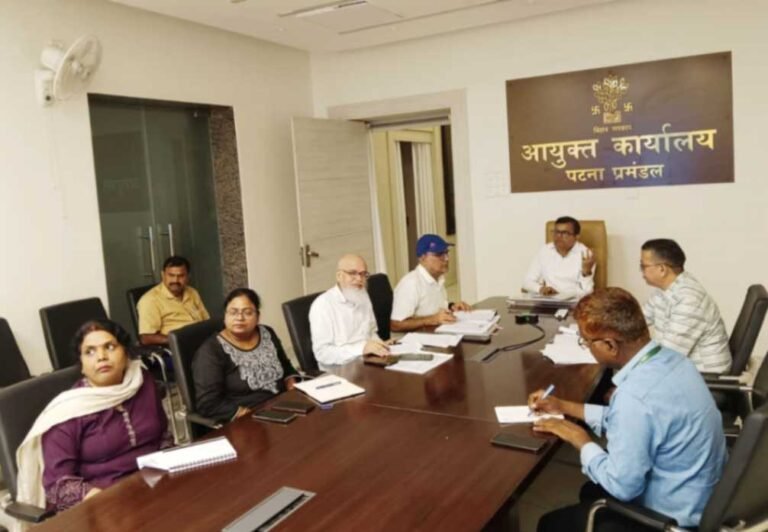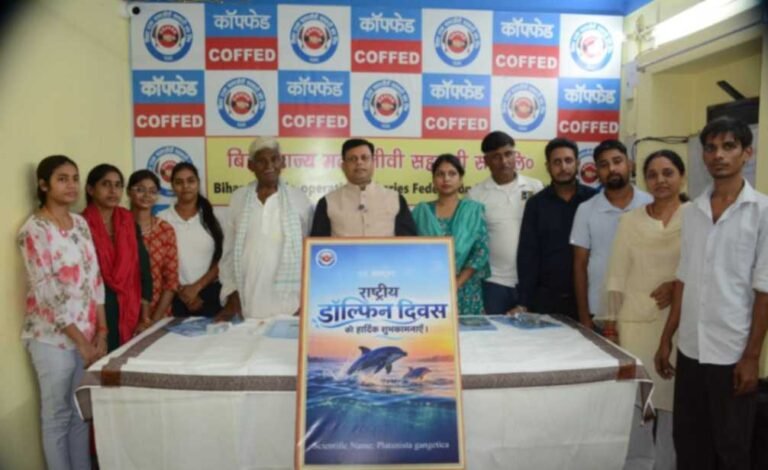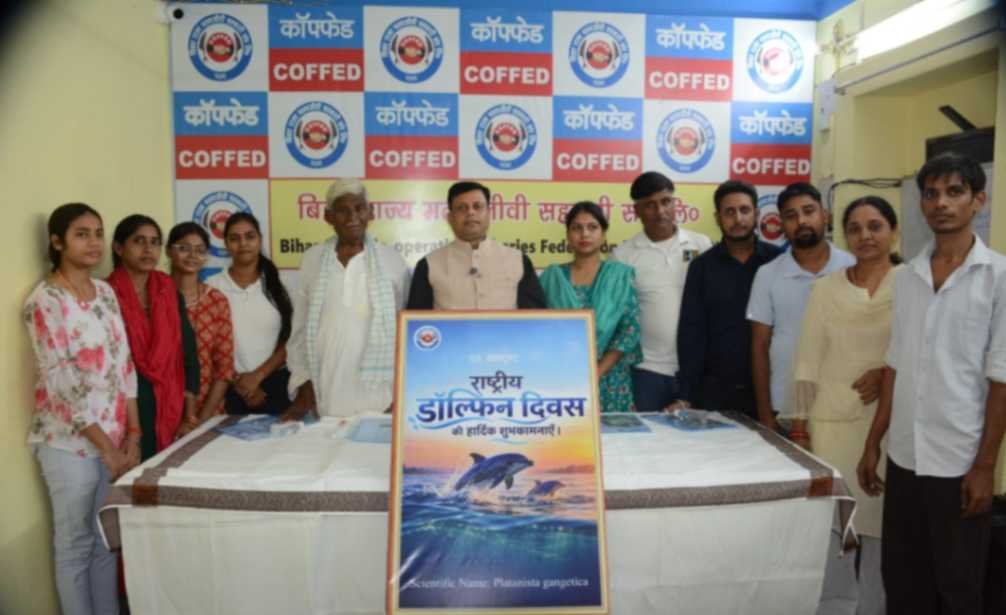
Patna: National Dolphin Day was observed at the headquarters of the Bihar State Fishermen’s Cooperative Federation Ltd (Coffed) on Monday, with participants stressing the need to strengthen efforts to conserve the Gangetic dolphin, protect its natural habitat, promote scientific research and public awareness, and involve fishing communities in conservation initiatives.
The discussions also focused on strengthening the institutional framework for dolphin conservation. Coffed said the Gangetic dolphin, India’s national aquatic animal, should not be viewed only through the lens of wildlife protection, but as part of a comprehensive policy linking river ecology, the livelihoods of traditional fishermen, scientific research, education, tourism and river transport.
Coffed managing director Rishikesh Kashyap said the presence of Gangetic dolphins was an important indicator of the ecological health of a river. He stressed the need for sustained coordination among the government, scientific institutions, fishermen’s cooperative societies, traditional fishing communities, educational institutions and local communities to protect dolphin habitats in the Ganga and other major rivers of Bihar.
Kashyap said Coffed had been raising issues related to dolphin conservation at the state and national levels through correspondence, awareness initiatives and policy interventions, and would continue to play an active role in protecting the national aquatic animal.
Strengthening dolphin research and conservation
Coffed called for the development of a strong Dolphin Conservation Project and Vikramshila Biodiversity Research and Education system in the Bhagalpur region, with dolphins and the biodiversity of the Ganga at its centre.
It also stressed the need to strengthen the National Dolphin Research Centre in Patna and develop it as a premier national institution for dolphin research, conservation, training and policy-making. Adequate financial, technical and human resources should be provided to the centre, it said.
Coffed also called for the appointment of a regular director at the National Dolphin Research Centre so that the institution could become fully operational and receive the financial support required for research and conservation programmes.
The federation proposed the establishment of a modern Dolphin Museum at the centre, displaying information on the biological characteristics and life cycle of the Gangetic dolphin, river ecology, conservation history and scientific research. The museum could serve as an awareness centre for students, researchers, tourists and the general public.
A specialised Dolphin Library was also proposed, with research papers, books, scientific reports, conservation laws and material on river ecology and aquatic biodiversity from India and abroad.
Coffed further suggested introducing undergraduate and postgraduate courses in Dolphin Studies, River Ecology and Aquatic Biodiversity in collaboration with the National Dolphin Research Centre, universities and other institutions. Such courses could help produce trained researchers, conservation experts and river ecology specialists.
The federation also called for scientifically prepared dolphin conservation and awareness material to be incorporated into school and college curricula to develop greater sensitivity among the younger generation towards rivers, aquatic biodiversity and the national aquatic animal.
Dolphin observatory proposed in Bhagalpur
Coffed stressed the need to establish a modern Dolphin Observatory/Dolphin Bhawan in the dolphin sanctuary area extending from Sultanganj to Bateshwar Sthan in Bhagalpur.
The proposed facility could become a centre for scientific observation, research, environmental education, controlled eco-tourism and public awareness. It could also help connect local fishing communities with environmental conservation while creating alternative employment and livelihood opportunities.
Coffed said traditional fishermen could play a particularly important role in dolphin conservation because they had generations of experience and knowledge of rivers.
It proposed creating posts for traditional fishermen as “Dolphin Mitras” at the National Dolphin Research Centre in Patna and in dolphin habitats along the Ganga, Gandak, Kosi and other rivers.
After training, these Dolphin Mitras could help monitor dolphin movements, report injured or distressed dolphins, flag illegal activities, assist scientific surveys and conduct awareness activities at the local level.
The federation also said the livelihood impact on traditional fishing families must be considered whenever fishing restrictions or other conservation controls were introduced. It called for compensation, alternative livelihood opportunities, training and special assistance schemes for affected fishermen.
“Conservation can become sustainable only when the local fishing community is both a beneficiary and a partner in conservation programmes,” Coffed said.
Fishermen to be represented in conservation committees
Coffed called for the constitution of an appropriate advisory committee under the relevant provisions of the Wildlife Protection Act, including Section 33B, with representation for scientists, administrative officials, conservation experts, traditional fishermen and fishermen’s cooperative organisations.
It said this would ensure that the practical experiences of riverine communities were taken into account while framing conservation policies.
The federation also proposed installing Dolphin Conservation and Awareness Boards at major ghats, embankments and riverfront areas along the Ganga, Gandak, Kosi and other dolphin-inhabited rivers.
The boards could provide information on identifying dolphins, conservation guidelines, prohibited activities, emergency contact numbers and the responsibilities of citizens.
Water Metro projects need dolphin safeguards
Coffed also raised concerns about proposed or upcoming Water Metro services on the Ganga and called for measures to protect dolphin habitats.
It suggested that scientific studies of dolphin habitats should be carried out before such transport projects begin. Clear environmental protocols should also regulate vessel speed, noise pollution, navigation routes and operations in sensitive areas.
In areas with high dolphin presence, measures such as speed regulation, no-horn and silent zones, designated navigation corridors and regular dolphin monitoring should be considered, it said.
The federation also called for regular training programmes, “Dolphin Schools” and workshops for fishermen, boat operators, students, teachers, local communities and administrative officials.
International conservation models
Coffed suggested studying successful international models for the conservation of dolphins and other aquatic mammals, particularly approaches based on community participation, scientific monitoring, eco-tourism and river transport management.
It said useful international practices could be adapted to Indian conditions to make Gangetic dolphin conservation programmes more effective.
The federation said National Dolphin Day, observed every year on October 5, should not remain a formal event but should become a broad public awareness campaign reaching schools, colleges, universities, panchayats, ghats, fishermen’s cooperative societies and riverine villages.
Coffed said it would expand awareness activities through its affiliated fishermen’s cooperative societies and fishing communities.
Kashyap said, “The Gangetic dolphin is our national aquatic heritage. Saving the dolphin does not mean saving only one species; it means protecting the entire biodiversity and ecology of the Ganga and its tributaries. Traditional fishermen, who have lived alongside these rivers for centuries, must be at the centre of this conservation process.”
He added: “Dolphins and fishermen are not adversaries. Both are integral parts of a healthy river ecosystem. If fishermen are trained as Dolphin Mitras and families affected by conservation measures are provided proper compensation and alternative livelihoods, Bihar can present a successful model of community-based dolphin conservation to the country.”
Coffed called upon the Centre and state government, the National Dolphin Research Centre, forest and environment authorities, the fisheries department, universities, scientific institutions, local bodies and fishing communities to work together on a comprehensive Dolphin Conservation and Community Participation Action Plan for the long-term protection of the Gangetic dolphin.
Those present at the programme included Rajendra Sahni, diver, and Cofffed officials and staff members Simran, Ravi Raj, Pramod Kumar Rajak, Amarendra Jha, Monu Kumar, Rani Sahni, Dayanand Kumar, Gopi Kumar, Kanchanwala, Amritesh Anand, Supriya, Bharti Kumar, Swastika Raj, Ravi Sahni and Krishna Kumar.
About the Author