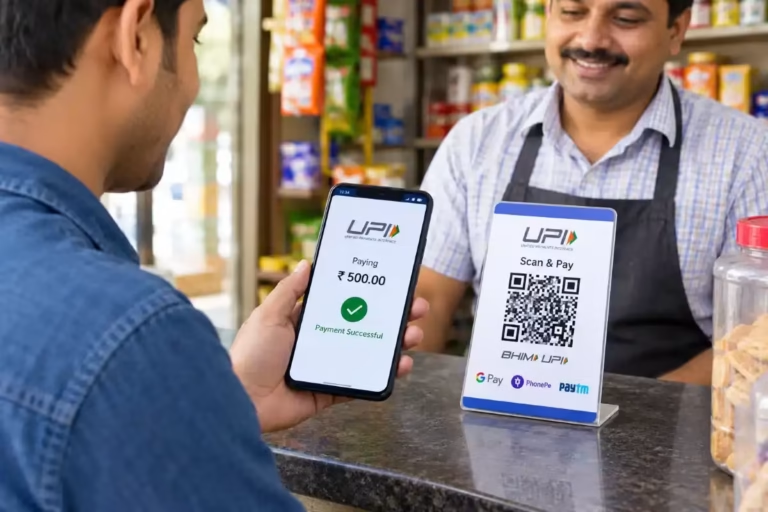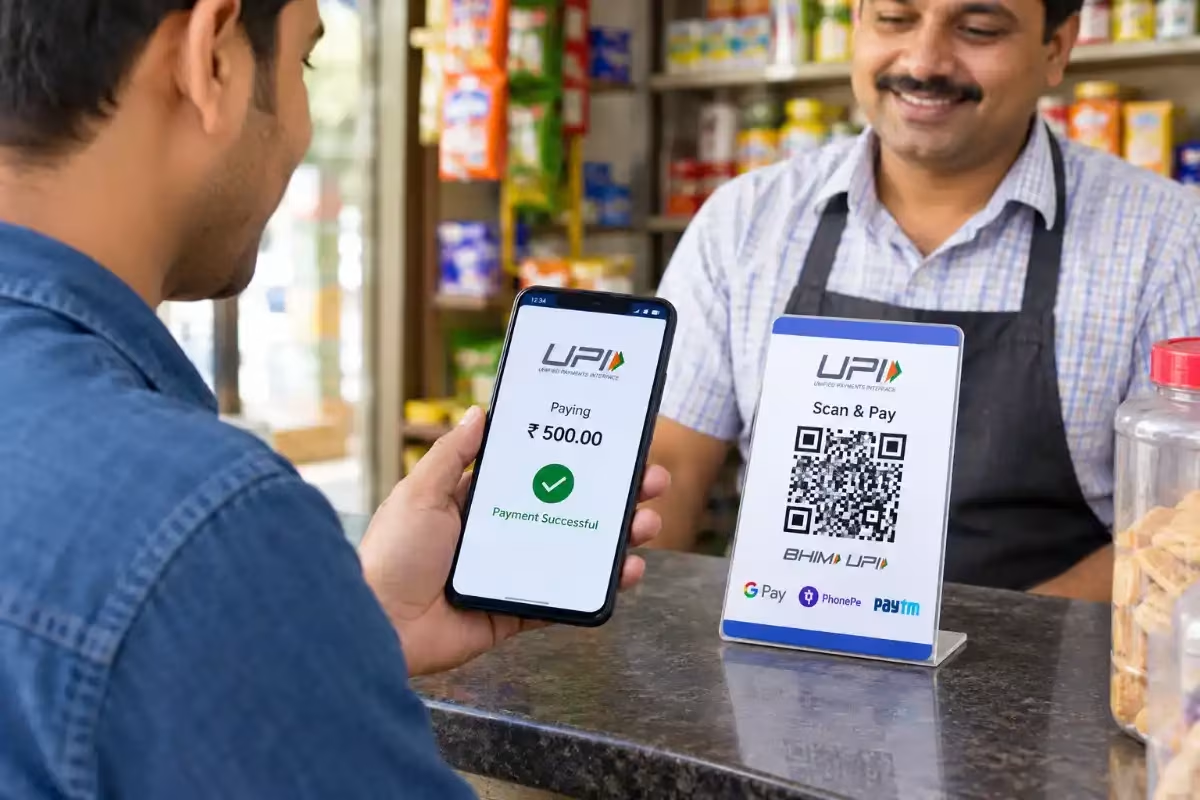
Payment through UPI. AI image
Patna: The National Payments Corporation of India (NPCI) has notified a Merchant Discount Rate of 0.4 percent on certain Unified Payments Interface (UPI) person-to-merchant transactions above Rs 2,000, effective October 15, 2026. The framework, announced on September 14, keeps all person-to-person transfers and merchant payments up to Rs 2,000 free of charge, while explicitly stating that consumers will not bear any new costs.
The charge, known as MDR, is a fee paid by merchants to their banks and payment service providers for processing digital transactions. Under the new structure, a 0.4 percent MDR applies to eligible P2M payments above Rs 2,000, with an absolute cap of Rs 300 per transaction for payments of Rs 75,000 and above.
For a Rs 3,000 payment, the MDR amounts to Rs 12. A Rs 50,000 transaction attracts Rs 200. On a Rs 1 lakh payment, the standard percentage calculation would yield Rs 400, but the Rs 300 ceiling applies instead, limiting the fee.
The NPCI stated that transactions up to Rs 2,000 will continue to carry zero MDR and account for more than 95 percent of UPI’s person-to-merchant transaction volume. Person-to-person transfers, including money sent to friends or family, remain free irrespective of the amount.
Small merchants operating under the Person-to-Person-Merchant framework will remain exempt from MDR. This category covers vendors receiving up to Rs 1 lakh per month through UPI QR codes directly into their bank accounts, including street vendors and small retail outlets. MDR applicability depends on the merchant’s overall account classification, meaning a single payment above Rs 2,000 does not automatically trigger charges for an exempt small merchant.
Concessional Rates for Essential Sectors
Several critical merchant categories will attract a flat MDR of Rs 5 per transaction above Rs 2,000 instead of the standard 0.4 percent rate. These include railways, telecom services, insurance premiums, and fuel purchases. Public utility payments such as electricity, municipal water charges, and piped natural gas also fall under this flat-fee structure.
The NPCI said the concessional flat-rate structure is intended to prevent cost escalation in critical public services, utility bill collections, and thin-margin sectors such as fuel retail. Insurance premium payments above Rs 2,000 will attract the flat Rs 5 fee to prevent high-value annual premiums from incurring larger backend charges.
Payments into mutual funds, securities, and through stockbrokers will attract a lighter MDR of 0.02 percent, capped at Rs 300. This rate is designed to keep the cost of investing low and encourage retail participation in formal financial markets.
Government Assurances and Merchant Protections
The Finance Ministry stated that consumers will not face any transaction charges, and banks have been directed to ensure merchants do not pass MDR costs on to customers. UPI app providers are barred from levying platform fees or hidden charges on individuals.
During the parliamentary debate on the amendment to the Payment and Settlement Systems Act, Finance Minister Nirmala Sitharaman had assured members that consumers would continue to make UPI payments free of charge. The amendment, passed during the Monsoon Session in August 2026, created the legal framework enabling MDR on UPI transactions.
Recurring payments made through UPI mandates or AutoPay, including utility bills and subscription services, will not attract the prescribed MDR charges. Credit-linked transactions such as RuPay credit cards on UPI follow separate card rules.
Rationale for the Framework
The NPCI stated that UPI processes billions of transactions monthly, and the costs of maintaining the platform have been borne by banks, NPCI, and payment service providers. The MDR revenue will be distributed among UPI ecosystem participants, including banks and app providers, to fund infrastructure resiliency, cybersecurity, innovation, and customer service.
The agency noted that the revised MDR remains lower than charges associated with credit cards, debit cards, and wallets. It described the charges as reasonable and applicable only to transactions above Rs 2,000 to ensure UPI remains an affordable mode of accepting payments. The framework also includes a dedicated fund to support digital payment infrastructure expansion among small merchants in Tier 3 and smaller markets.
For transactions of Rs 75,000 and above, the MDR is capped at Rs 300 per transaction, providing predictability for high-value payments. The operational parameters, fee-distribution models, and category-specific caps will be decided by the UPI and Services Steering Committee headed by NPCI.
The new MDR framework takes effect on October 15, 2026, giving acquiring banks, payment aggregators, and fintech applications time to update their software and billing systems.
About the Author