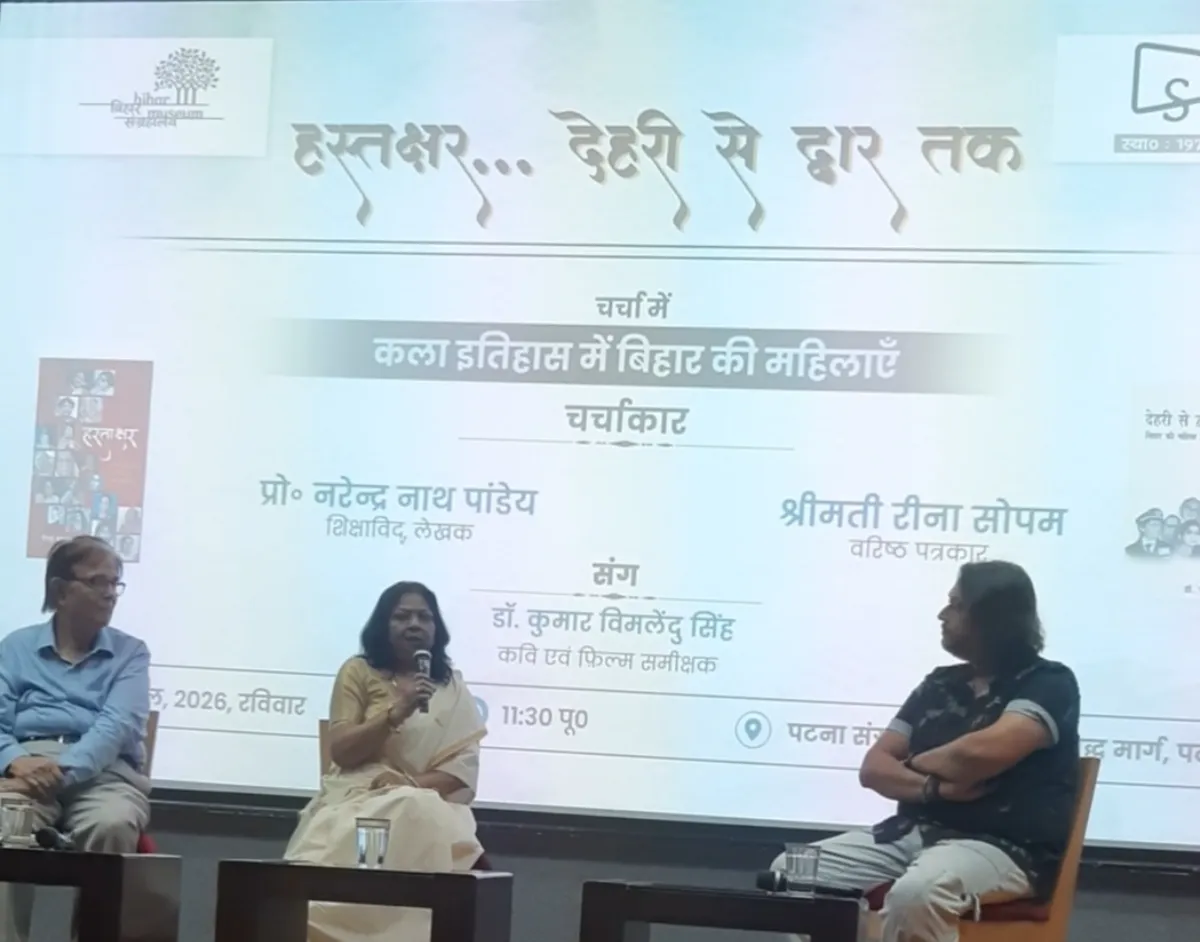
Senior journalist Reena Sopam (middle) discussing the role of Women of Bihar in Art History in Patna on April 19, 2026.
By A Correspondent
Patna: A thought-provoking discussion on the theme “Women of Bihar in Art History” was held at the Patna Museum auditorium on Sunday, highlighting the need to re-evaluate the contribution and participation of women in the state’s artistic legacy.
The session featured noted theatre practitioner and author Prof. NN Pandey and senior journalist and art writer Reena Sopam, who shared their perspectives on the subject. The event was organised jointly by Cine Society and Patna Museum, with young poet Kumar Vimalendu moderating the discussion.
Introducing the theme, Prof. Jaymangal Dev said that recent publications—Prof. Pandey’s Dehri Se Dwar Tak and Reena Sopam’s Hastakshar: Women in Bihar’s Art History—place women at the centre of discourse, a subject that has long remained neglected and therefore warranted serious discussion.
Kumar Vimalendu observed that such books focusing on women have appeared after a long gap, adding that even their titles evoke curiosity about their conceptualisation.
Reena Sopam explained that Hastakshar focuses exclusively on women artists in the performing arts, many of whom hailed from prominent families in Bihar and were actively engaged in various artistic fields in the years following Independence. She noted that these women played a vital role in sustaining India’s ancient artistic traditions, yet their contributions were seldom documented.
Recalling her encounters during her journalistic career, Sopam said she felt compelled to preserve their legacies, leading to the compilation of their biographies into a book. The work features personalities such as Kumud Akhauri, Vindhyavasini Devi, Shanti Jain, Sharda Sinha, Kathak artistes Chandana De and Rama Das, Akashvani actress Shanti Devi, theatre personality Navneet Sharma, and film actress Noor Fatima. It also sheds light, for the first time, on the significant contributions of women like Ajiza Imam, Savitri Devi, and Uma-Gauri Chatterjee in the field of art preservation.
“Hastakshar is, in essence, an attempt to correct the long-standing oversight of women’s achievements and contributions in our society,” Sopam remarked.
Prof. Pandey shared that his long association with Doordarshan and Akashvani enabled him to create feature programmes on distinguished women across various fields. These interactions eventually took the shape of his book, which documents not only women artists but also those who excelled in education, nursing, social service, and broadcasting.
Speaking about the challenges faced during the writing process, Sopam noted that most of the artists featured in Hastakshar belong to the third generation, many of whom are unaware of their predecessors’ achievements, making it difficult to gather information and photographs. Prof. Pandey echoed similar challenges in his own work.
The programme concluded with a vote of thanks by Cine Society’s Prashant Kumar, while Kumar Vimalendu conducted the proceedings. Several prominent citizens of the city, including Prof. Indrakant Jha, BK Jain, Shyamal Das, Sarita, Bharti Sharma, Dr Rekha, Dr Rita Das, and Sushma Pandey, were present on the occasion.
About the Author