Patna High Court
From Neeraj Kumar
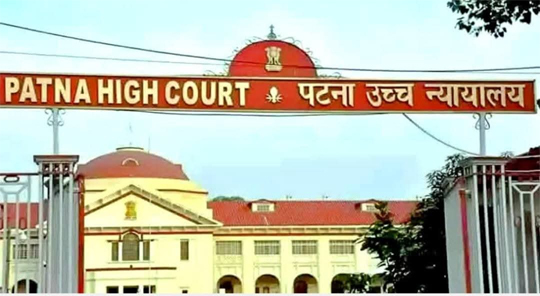
Patna: The Patna High Court has directed all trial courts across Bihar to strictly follow the prescribed rules under the state’s prohibition law, observing that the provisions are often being ignored at the trial level.
Justice Arun Kumar Jha, hearing a petition filed by Shamsher Bahadur, ordered the High Court Registrar General to circulate the court’s directions to all trial courts in the state. A copy of the order has also been sent to the Director of the Bihar Judicial Academy to ensure that judicial officers are properly trained in the legal procedures under the prohibition law.
The court noted serious lapses in the handling of prohibition cases by trial courts and, in this backdrop, quashed an FIR registered under the prohibition law at Singheshwar police station in Madhepura district (Case No. 69/2021).
The High Court instructed all courts dealing with prohibition cases to strictly adhere to the rules laid down under the Bihar Prohibition and Excise Rules. It clarified that when an accused agrees to plead guilty, the statement must be recorded in the prescribed Form VI-A under Rule 18, followed by an order in the prescribed Form VII.
The case relates to Singheshwar police station, where the applicant and another person were arrested on March 25, 2021, on charges of consuming alcohol. The petitioner contended that the police neither conducted a breath analyser test nor collected blood or urine samples. Instead, a case was registered solely on the basis of a doctor’s opinion that the accused appeared to be under the influence of alcohol.
It was further submitted that, in an attempt to bring the matter to an early close, the applicant moved the trial court seeking permission to deposit a fine and have the case disposed of. The trial court directed him to pay a fine of ₹2,000 and, in default, imposed a sentence of one month’s simple imprisonment, after which the case was disposed of.
The petitioner argued that he had never admitted guilt and had paid the fine only on the basis of incorrect legal advice. However, the trial court’s order suggested that he had pleaded guilty. In reality, he maintained his innocence and merely wished to avoid prolonged litigation, for which he was willing to pay the fine.
The High Court agreed that the trial court had passed the order without following the mandatory legal provisions. Under Rule 18 of the Bihar Prohibition and Excise Rules, 2021, a specific format is prescribed for recording orders in Form VII. Moreover, when an accused is produced before the court under Section 37 of the Bihar Prohibition and Excise Act, 2016, the court must first ascertain whether the accused voluntarily pleads guilty. Only upon such admission can further action be taken.
The court found that the trial court’s order did not conform to the prescribed format under Rule 18. Neither was the petitioner’s statement recorded in Form VI-A, nor was the order drawn up in Form VII, rendering the proceedings legally unsustainable.
About the Author