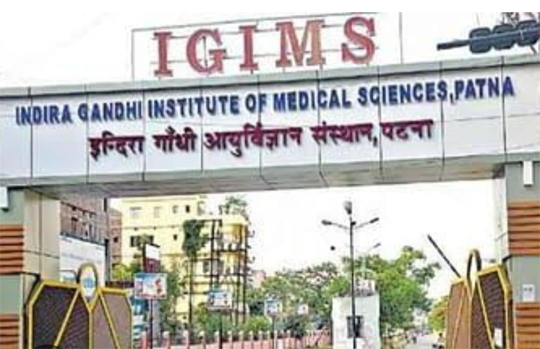
IGIMS Patna
By Neeraj Kumar
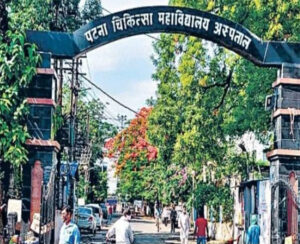
Patna: Patients seeking treatment in Bihar government hospitals are first forced to endure long and exhausting waits. Outpatient departments (OPDs) of the state’s major and reputed public hospitals are witnessing such overwhelming crowds that patients are compelled to stand in queues for hours before receiving any medical attention. From registration to consultation with doctors and finally obtaining medicines, each step is taking several hours, causing severe physical and mental distress not only to patients but also to their attendants.
What is the Bhavya App?
To monitor the time taken from a patient’s arrival at the hospital to registration, consultation and medicine distribution, the government has introduced the Bhavya App. The app stores complete patient data. Once registered, patients no longer need to carry bulky files for repeat visits. Details of diagnosis, investigation reports and prescribed medicines are digitally available, enabling doctors to review previous treatment history instantly during future consultations.
Longest waits at medical college hospitals
In cities like Patna, home to major institutions such as PMCH, NMCH and IGIMS, the situation remains far from satisfactory. Patients arriving early in the morning hope to complete treatment by afternoon, but in many cases, their turn does not come even by evening. For elderly patients, women and those suffering from serious illnesses, the prolonged wait is particularly painful. Data from the Bhavya App clearly indicates extended waiting times at large medical institutions.
Patna records higher-than-average waiting time
According to Bhavya App data, the national average OPD waiting time is around 38 minutes. However, Bihar’s major government hospitals are well above this benchmark. At PMCH, patients wait an average of 75 to 85 minutes. IGIMS records waiting times of 60 to 70 minutes, while NMCH patients wait between 55 and 65 minutes. The situation worsens further when doctor availability is low or certain departments witness sudden surges in patient numbers.
Katihar fares better with shorter queues
Shockingly, delays are not limited to doctor consultations alone. At PMCH and IGIMS, patients often stand in queues for 1.5 to 2 hours at medicine counters even after completing registration and investigations. However, the situation is not uniform across the state. In districts like Katihar, improved registration systems have reduced average waiting time to around 25 minutes. In contrast, districts such as Siwan report an average wait of nearly 65 minutes.
Shortage of doctors a key concern
Experts attribute the crisis primarily to a shortage of doctors and staff in proportion to patient load. Former IMA Bihar president Dr Ajay Kumar said the shortage of specialist doctors is more severe in the government sector than in private hospitals. A major reason is dependence on outsourced doctors, whose contracts often end without a clear continuity process. Contractual posts also lack promotion and pay revision policies, prompting many doctors to leave government service and start private practice.
Large campuses add to delays
Dr Kumar explained that when one doctor is responsible for hundreds of patients, overcrowding in OPDs becomes inevitable. While registration slips may be issued in a minute, a doctor requires 5 to 10 minutes per patient, resulting in long queues. Medical college hospitals also span vast campuses, with registration counters, OPDs of various departments and medicine counters located far apart, significantly increasing overall processing time.
He added that medical college hospitals offer better diagnosis and treatment, as senior doctors train junior doctors during patient care. Patients are advised to allocate at least two to four hours for OPD visits, while emergency cases are handled separately. Those who book time slots through the system can be seen within the allotted half-hour window.
Overburdened medicine counters
Dr Kumar further pointed out that patients from multiple departments converge at a limited number of medicine counters—often just one or two. With 26 to 27 OPDs handling between 3,000 and 7,000 patients daily, dispensing medicines becomes time-consuming. Prescriptions range from a single drug to as many as seven, and locating and issuing these medicines takes considerable time. “The focus should be on quality treatment, not just speed,” he said.
Manpower shortage persists
Bihar continues to face a severe shortage of doctors and healthcare manpower. Experts stress the need for a long-term policy to retain doctors in government hospitals. After completing five years of MBBS education, doctors are offered contractual salaries of around ₹65,000, often without residential facilities at PHC levels, forcing long commutes. Diagnostic facilities such as ultrasound, X-ray and MRI machines are also overburdened, with MRI appointments sometimes scheduled 10 to 15 days later.
Need to boost manpower capacity
Experts believe the problem cannot be solved merely by constructing new buildings or introducing apps. There is an urgent need to increase the number of doctors and paramedical staff, simplify registration and medicine distribution by adding more counters, and allocate OPD slots based on patient volume. Strengthening primary health centres is equally important to prevent overcrowding at major hospitals. Increasing the number of diagnostic machines at large hospitals is also essential.
Better experience at New Gardiner Road Hospital
Some super-speciality hospitals with limited departments report significantly shorter waiting times. At Patna’s New Gardiner Road Hospital, patients complete registration, consultation and medicine collection within 30 minutes to an hour. Vishal Kumar, a patient visiting for a skin-related issue, said his mobile number was taken during registration, after which he received an SMS. “I met the doctor within five minutes and am now collecting my medicines,” he said.
Avinash Mishra, an attendant of another patient, said, “I came yesterday for treatment and returned today with test reports. Yesterday, the entire process—from registration to blood sample and medicines—took around one to one-and-a-half hours.”
Slot booking through Bhavya App
Hospital superintendent Dr Manoj Kumar Sinha said all procedures at New Gardiner Road Hospital are completed within 20 to 30 minutes. “The Bhavya App is excellent. Patients can register and book slots from home,” he said. For elderly patients without mobile phones, data operators register them using their own numbers. The app stores prescriptions and test reports, aiding doctors in future diagnosis and sparing patients from carrying heavy files.
Bihar categorised as ‘High Focus State’
The Union Health Ministry has placed Bihar in the ‘High Focus State’ category under the Bhavya App initiative, indicating the need for special attention and resources to improve healthcare services. While plans are underway to strengthen infrastructure, recruit doctors and enhance digital systems, experts say the impact is yet to be clearly visible on the ground. Comparatively, states such as Kerala, Tamil Nadu and Delhi report far shorter waiting times, with patients in Delhi and Punjab typically seeing doctors within 25 to 40 minutes.
About the Author