Bihar Chief Minister Nitish Kumar's car
From Neeraj Kumar
Patna: Bihar Chief Minister Nitish Kumar’s fondness for the number seven is no secret. Widely regarded as his lucky number, seven features prominently in his vehicle numbers, official residence and, most notably, his flagship development programmes. From Saat Nischay launched in 2015 to Saat Nischay–2 in 2020 and now Saat Nischay–3 in 2025, the Chief Minister’s attachment to the number has once again come into focus.
Has Seven Proved Lucky for Nitish Kumar?
Since the launch of the Saat Nischay programme, Nitish Kumar has remained Chief Minister, strengthening the belief among supporters that the scheme — and the number seven — has been lucky for him. The Chief Minister also frequently invokes Mahatma Gandhi’s concept of the “seven deadly sins” while attacking the Opposition.
Car, Bungalow and Schemes — All Number Seven
Political analyst Arun Pandey points out that when Nitish Kumar assumed power in Bihar in 2005, a vehicle bearing the number seven became part of his convoy. Later, a bungalow numbered seven was reserved for him. Even when he briefly stepped down from office, he continued to use a vehicle with the same number. The *Saat Nischay* programme, meanwhile, has continued uninterrupted.
Pandey notes that in 2015, Nitish Kumar returned to power with full force on the strength of the Saat Nischay agenda. Irrespective of coalition changes, he has remained Chief Minister for the past decade. “Since the launch of this programme, its significance for Nitish Kumar has only grown,” he said.
‘If the Heart Is Clean, Any Number Works’
When asked about the Chief Minister’s attachment to the number seven, senior minister and Nitish Kumar confidant Shravan Kumar dismissed the notion of numerology. “If the heart is clean, any number works,” he said, adding that the Chief Minister’s vision, thinking and commitment are dedicated entirely to the people of Bihar.
‘Saat Nischay Cannot Be Forgotten’
Shravan Kumar explained that the success of Saat Nischay–1 prompted the launch of Saat Nischay–2, and positive results from the second phase led to Saat Nischay–3. “The focus has always been on how to take Bihar forward,” he said.
With the public giving the government another five-year mandate, Saat Nischay–3 has been introduced, promising one crore jobs and employment opportunities. “Earlier promises under *Saat Nischay–2* were fulfilled, and this time too, commitments will be met,” the minister asserted.
‘For Us, Every Number Is Lucky’
On the Chief Minister’s preference for vehicles and residences bearing the number seven, Shravan Kumar remarked that for the past 20 years, “every number has been lucky” for the government, thanks to the trust shown by the people of Bihar. He expressed confidence that 2026 would mark a new phase of progress for the state.
Saat Nischay–1 (2015–2020): Seven Agendas
1. Economic empowerment of youth
2. Reserved employment for women
3. Electricity for every household
4. Tap water in every home
5. Paved streets and drainage up to every house
6. Construction of toilets — dignity for every home
7. More opportunities, greater progress
Saat Nischay–2 (2020–2025): Seven Agendas Again
1. Youth power for Bihar’s progress
2. Empowered and capable women
3. Irrigation water to every field
4. Clean villages, prosperous villages
5. Clean cities, developed cities
6. Improved connectivity
7. Additional healthcare facilities for all
Saat Nischay–3: Seven New Priorities
1. Double employment, double income
2. Prosperous industry, empowered Bihar
3. Agricultural growth for state prosperity
4. Advanced education, brighter future
5. Accessible healthcare, secure life
6. Strong foundations, modern expansion
7. Dignity for all, easier living
Gandhi’s Seven Sins
The Chief Minister often refers to Mahatma Gandhi’s “seven deadly sins”, which have been prominently displayed in the Assembly, Legislative Council, Secretariat, government offices, schools and other major institutions across the state.
1. Wealth without work
2. Pleasure without conscience
3. Science without humanity
4. Knowledge without character
5. Politics without principle
6. Commerce without morality
7. Worship without sacrifice
Even the Car Number Ends in Seven
The vehicle used by the Chief Minister typically ends with 07 or 77. While several vehicles are part of the convoy, Nitish Kumar is usually seen travelling in one bearing his preferred number.
A Bungalow Numbered Seven
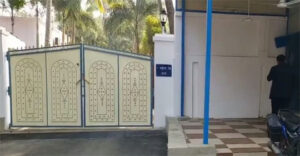
After resigning in the wake of the JD(U)’s poor performance in the 2014 Lok Sabha elections, Nitish Kumar made the bungalow at 7 Circular Road his residence, where he stayed for a long period. Although it was briefly allotted to then Chief Secretary Deepak Kumar, it has remained largely associated with the Chief Minister. Whenever repair work is undertaken at the official residence, Nitish Kumar shifts to this bungalow.
Even His Mobile Number Had Seven
Party leaders claim that in his early political days, Nitish Kumar owned an Ambassador car with the number seven, and even his mobile phone once ended with the same digit. They argue that his distinctive political style and initiatives like Saat Nischay set him apart from other leaders.
“Whether seven is truly lucky or not is for the Chief Minister to say,” remarked Neeraj Kumar, JD(U) chief spokesperson. “What matters is the work.”
Coincidence or Strategy?
Many people believe in lucky numbers, and Nitish Kumar’s association with seven is evident. Each phase of Saat Nischay has featured seven agendas — never eight, only seven. Interestingly, Saat Nischay–3 was implemented on December 16; add the digits together, and the result is once again seven. Coincidence or strategy — the answer perhaps lies with the Chief Minister himself.
About the Author