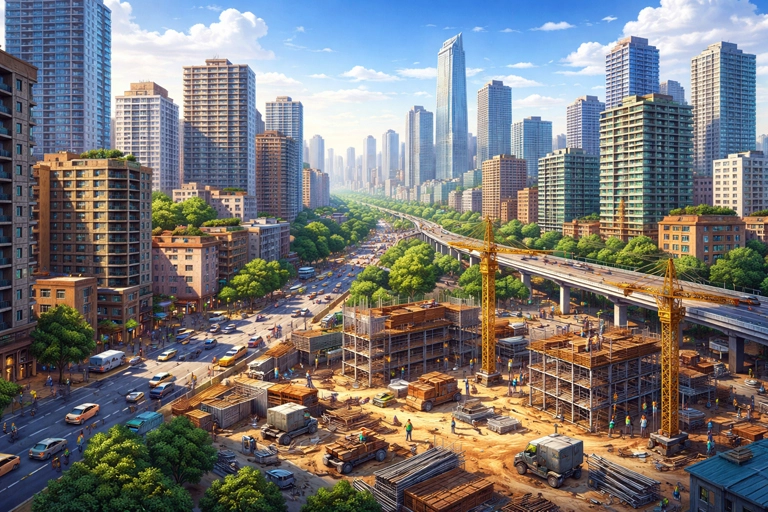
Policy Continuity and Capex Boost Accelerate India’s Urbanisation Story
Delhi NCR: The Union Budget has sent a clear signal that urbanisation will remain central to India’s long-term growth strategy. By raising public capital expenditure to Rs 12.2 lakh crore and sustaining an infrastructure-first approach, the government aims to strengthen the physical and economic foundations needed for cities to expand, new urban centres to emerge and regional economies to mature.
Industry leaders say the continuity in infrastructure spending, regional connectivity and urban development policies is creating favourable conditions for the next phase of urban transformation. This phase, they note, will see Tier-2 and Tier-3 cities evolve into independent economic hubs rather than remaining satellite extensions of major metros.
Manoj Gaur, CMD of Gaurs Group, said the Budget builds on the momentum witnessed in the real estate sector over the past few years. He added that sustained infrastructure spending would boost office, retail and mixed-use developments, strengthen job creation and spur demand for housing. The proposed Infrastructure Risk Guarantee Fund, he noted, would further accelerate expansion, particularly in emerging cities.
Urbanisation, industry executives pointed out, is being driven not only by physical infrastructure but also by improved financing mechanisms that reduce risk and enable large-scale development. Sahil Agrawal, CEO of Nimbus Group, said the increase in capital expenditure provides visibility and confidence for long-gestation projects across metros as well as Tier-2 and Tier-3 cities. He also welcomed the introduction of dedicated REITs for public sector assets and the Infrastructure Risk Guarantee Fund, saying these measures would unlock capital, mitigate execution risks and improve project delivery timelines.
Higher allocations for urban infrastructure and increased fiscal transfers to states are expected to accelerate residential and commercial development in emerging regions. Deepak Kapoor, Director of Gulshan Group, said the Budget creates a stable framework for sustained real estate growth, with infrastructure-led development playing a critical role in expanding housing and commercial opportunities beyond metropolitan areas.
Connectivity upgrades, particularly high-speed rail corridors, are emerging as powerful drivers of urbanisation. Uddhav Poddar, CMD of Bhumika Group, said the announcement of seven high-speed rail corridors would improve accessibility between major cities and emerging urban centres, unlocking new residential and commercial micro-markets along these routes. He added that measures to upgrade construction and infrastructure equipment would enhance execution efficiency and reduce project timelines.
As infrastructure investment creates new job centres, commercial ecosystems are expected to deepen outside traditional central business districts. Harinder Singh Hora, Founder Chairman of Reach Group, said increased government spending and the focus on City Economic Regions would drive demand for offices, business parks, logistics and mixed-use commercial developments in Tier-2 and Tier-3 cities.
Improved infrastructure quality is also expected to reduce development risks and attract institutional capital. B.K. Malagi, Vice Chairman of Experion Developers, said sustained public capex and better construction capabilities would enhance asset longevity and make emerging markets more attractive to investors.
While the sector had hoped for tax and approval-related reforms, many stakeholders see the Budget as prioritising structural enablers over short-term demand incentives. Sandeep Chhillar, Founder and Chairman of Landmark Group, said the focus on infrastructure and mobility would reshape commuting patterns, unlock peripheral residential markets and ease pressure on core urban areas.
Echoing this view, Bhupindra Singh, COO of RISE Infraventures, said the Budget marks a decisive push towards strengthening Tier-2 and Tier-3 cities as India’s next growth engines. Improved connectivity and faster project execution, he said, would allow smaller cities to evolve into self-sustaining urban economies.
Overall, industry experts believe policy continuity and sustained capital expenditure are not only supporting the real estate sector but are actively shaping India’s urbanisation trajectory, expanding the country’s city network and laying the groundwork for more balanced, infrastructure-backed urban growth.
About the Author