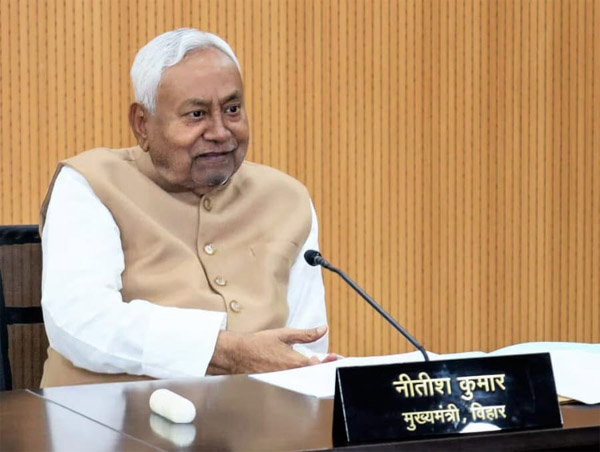
Bihar Chief Minister Nitish Kumar, File Photo
By Neeraj Kumar
Patna: The second day of the Bihar Legislature’s Budget Session saw the presentation of the state’s General Budget for the financial year 2026–27 in the Assembly. Finance Minister Bijendra Prasad Yadav tabled a budget of Rs 3,47,589.76 crore, noting that the size of Bihar’s budget has steadily increased over the past few years.
The highest allocation—Rs 68,216.95 crore—has been earmarked for education and higher education. Rural development has been allotted Rs 23,701.18 crore, while the health sector will receive Rs 21,270.40 crore. The Home Department (police and security) has been assigned Rs 20,132.87 crore and the Energy Department Rs 18,737.06 crore.
Under the Chief Minister’s Kisan Samman Nidhi scheme, farmers will receive additional annual assistance of Rs 3,000. The budget also proposes promotion of cold storage facilities, processing units and agri-start-ups, along with a target of ensuring irrigation water reaches every field.
Several departments—including Building Construction, Disaster Management, Finance, Agriculture and Industries—have each been allocated more than Rs 3,000 crore. The Education Department alone accounts for 17.32 per cent of the total budget. Pension expenditure has been fixed at Rs 35,170.48 crore (10.12 per cent of the budget), while Rs 25,363.67 crore has been provided for interest payments and Rs 22,664.83 crore for loans.
The state expects to receive Rs 2,10,074.12 crore from the Centre, including Rs 1,58,178.32 crore as its share of central taxes and Rs 51,895.80 crore as grants-in-aid. Bihar estimates its own tax revenue at Rs 65,800 crore and non-tax revenue at Rs 9,402.98 crore, taking total state revenue receipts to Rs 95,202.98 crore.
The Finance Minister said more than 1.56 crore women associated with self-help groups have already been given assistance of Rs 10,000 each, with a provision for additional support or loans of up to Rs 2 lakh to expand businesses. He said women have made the JEEViKA model a major source of livelihood.
Allocations of Rs 19,603 crore for Scheduled Castes and Rs 1,648 crore for Scheduled Tribes have been made under separate heads to ensure direct benefits.
According to the budget, the government aims to create one crore jobs between 2025 and 2030 and attract private investment worth Rs 50 lakh crore. Plans include setting up model schools and degree colleges in every block, along with a strong focus on skill development and youth training.
Per capita electricity consumption in the state has risen to 374 units, with rapid expansion of solar and renewable energy. The budget also outlines expansion of rural roads, affordable housing for the urban poor, extension of Ganga water supply schemes, flood control measures, river-linking projects and fast-tracking of major and medium irrigation projects.
Total revenue receipts have been estimated at Rs 2,85,277 crore, including Rs 65,800 crore from the state’s own taxes and Rs 1,58,178 crore as central assistance and grants. Presenting the budget, Finance Minister Bijendra Yadav said Bihar was progressing faster than many other states and would move ahead with renewed resolve under the ‘Saat Nischay–3’ programme.
About the Author