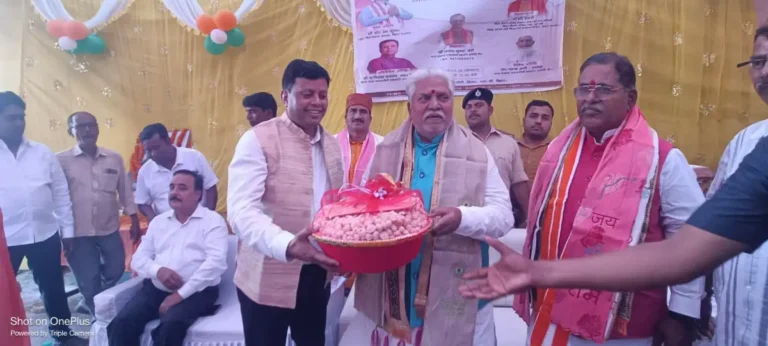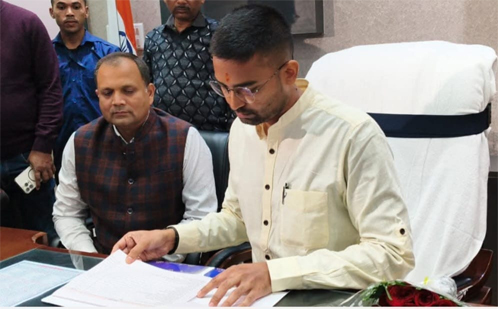
Bihar Panchayati Raj Minister Deepak Prakash
From Neeraj Kumar
Patna: Panchayat elections in Bihar are due to be held in 2026 and will be markedly different from previous polls, with all reserved seats at the panchayat level set to change. The elections will follow the three-tier system, covering Gram Panchayats, Panchayat Samitis and Zila Parishads.
Bihar has 8,053 Gram Panchayats, 533 Panchayat Samitis and 38 Zila Parishads. The total number of wards across Gram Panchayats is around 1.15 lakh. According to the Panchayati Raj Department, nearly 2.48 lakh representatives are elected in panchayat elections, including Panch, Sarpanch, Ward Members, Mukhiya, Panchayat Samiti Members and Zila Parishad Members.
Under the provisions of the Bihar Panchayati Raj Act, 50 per cent reservation is mandated for women. As a result, seats currently represented by women will be contested by men in the next election, while seats held by men will be reserved for women.
In addition to women’s reservation, seats are also reserved for Scheduled Castes (SC), Scheduled Tribes (ST), Other Backward Classes (OBC) and, in some areas, Extremely Backward Classes (EBC). However, the 2026 elections will be held without fresh delimitation and will be conducted as per the 2011 Census. This was confirmed by state Panchayati Raj Minister Deepak Prakash in an exclusive interaction.
Speaking on the 2026 Panchayat elections, Minister Prakash said there is a fixed reservation roster, and as per the Panchayati Raj Act, reserved seats are revised every 10 years. Accordingly, the reservation roster will change this time as well, and the State Election Commission is currently engaged in preparing the new roster.
He clarified that delimitation will not change in this election due to the absence of new census data. The 2021 Census could not be conducted because of the Covid-19 pandemic. While the reservation roster will be revised, delimitation will remain unchanged. The elections will be held on time, and the tenure of the current representatives will be completed before the polls are concluded.
The minister further said that Multi-Post EVMs will be used in the 2026 Panchayat elections. EVMs will be deployed for all six posts, with one control unit and six ballot units. This, he said, will make election management and voting more convenient.
With fewer machines required, monitoring will be easier and costs will be significantly reduced. Panchayat elections are conducted on a large scale, involving the election of representatives to multiple posts. Ensuring transparency and free and fair elections remains the top priority. In the previous panchayat elections, the polls for Panch and Sarpanch were held using ballot papers.
Highlighting the use of technology, Minister Prakash said Multi-Post EVMs are just one of several technological interventions planned. Facial recognition will be used during voting to prevent bogus voting. If a voter attempts to vote more than once, facial identification will help detect it, a step expected to reduce election-related violence.
For error-free counting and public convenience, Optical Character Recognition (OCR) technology will be used during vote counting. Votes will be counted manually as well, and the entire counting process will be recorded. Multiple technologies are being adopted to ensure that the election process remains free and fair.
On digital literacy among panchayat representatives, the minister said the Panchayati Raj Department regularly organises workshops and training programmes to build the capacity of elected representatives. Training is conducted throughout the year through District Panchayat Resource Centres (DPRC) and State Panchayat Resource Centres (SPRC). Greater use of technology in the election process will also enhance convenience for voters.
Speaking on ‘Saat Nischay–3’, Minister Prakash said that in line with the mandate received in the Assembly elections, Chief Minister Nitish Kumar aims to include Bihar among the country’s top five developed states. Saat Nischay–3 has been formulated to translate this vision into action and to place Bihar among the leading states.
On questions regarding the renaming of MGNREGA, the minister said it should not be viewed as the removal of Mahatma Gandhi’s name from the employment guarantee scheme. Instead, he said, the association reflects that Mahatma Gandhi was a follower of Lord Ram. He added that the scheme’s content has been improved, with the guaranteed days of employment increased from 100 to 125.
He pointed out that earlier, while people did receive work, it often did not lead to productive outcomes. Activities such as digging and refilling soil provided employment but yielded little social benefit.
Minister Prakash said the changes align with Prime Minister Narendra Modi’s vision of making India a developed nation by 2047. The objective is to provide employment while also creating long-term assets that contribute to social prosperity. The new provisions are expected to accelerate rural development and strengthen villages. Notably, the Central government has introduced a Bill in Parliament to rename MGNREGA as the Viksit Bharat Guarantee for Rozgar and Aajeevika Mission Gramin (VB-G-RAM).
About the Author