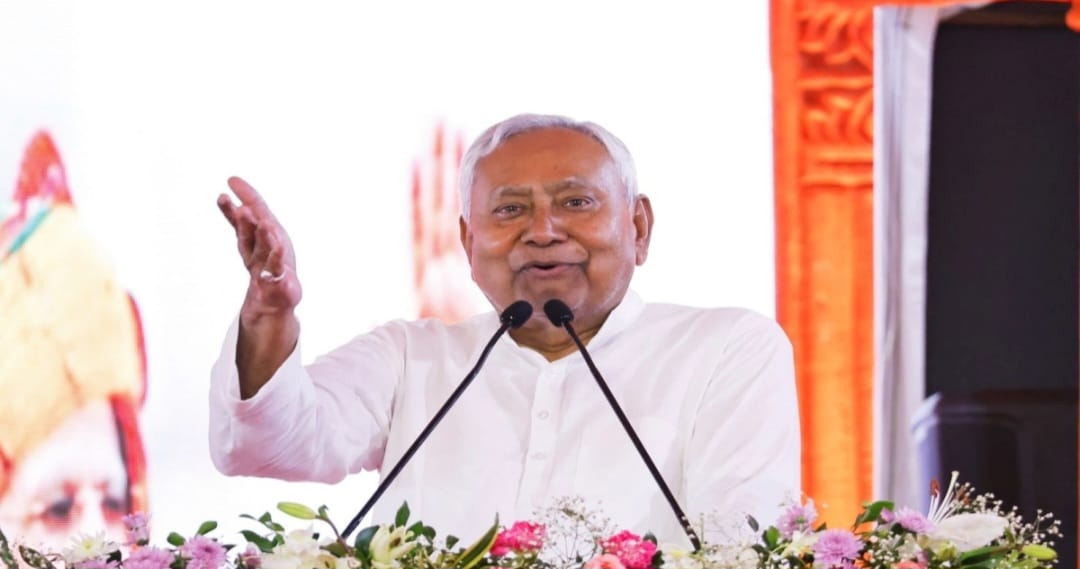
Bihar Chief Minister Nitish Kumar
From Neeraj Kumar
Patna: The Bihar Cabinet, chaired by Chief Minister Nitish Kumar, on Tuesday approved a series of key decisions, including the launch of the ambitious ‘Saat Nischay-3’ programme aimed at accelerating the state’s overall development. The Chief Minister shared details of the decisions in a post on social media platform X.
Nitish Kumar said that since his government assumed office on November 24, 2005, the rule of law has been firmly established in Bihar, and sustained efforts have been made over the past 20 years for the development of all sectors and sections of society.
He said that after achieving the targets set under the Good Governance programmes—Saat Nischay (2015–2020) and Saat Nischay-2 (2020–2025)—with the guiding principle of “development with justice”, the government has now decided to implement Saat Nischay-3 to place Bihar among the most developed states in the country.
The Chief Minister said that a caste-based enumeration along with a socio-economic survey was conducted in 2023, under which 9.4 million identified poor families will be prioritised for employment schemes and provided additional financial assistance wherever required. Haats and local markets will also be developed to promote the sale of Bihar’s products.
Explaining the first resolution of Saat Nischay-3, Nitish Kumar said it focuses on “Double Employment, Double Income”, with the objective of doubling the state’s per capita income. Several programmes have been launched towards this goal. Under the Chief Minister’s Women Employment Scheme, women are being provided ₹10,000 for self-employment, with further assistance of up to ₹2 lakh to expand their ventures.
A target has been set to create jobs and employment opportunities for one crore youths over the next five years. For this purpose, a separate Department of Youth, Employment and Skill Development has already been constituted.
The second resolution, titled “Prosperous Industry, Empowered Bihar”, aims at rapid industrial growth. Three high-level committees headed by the Chief Secretary have been formed to transform Bihar into a new technology hub of eastern India and develop it as a world-class workplace. The initiative also seeks to encourage leading entrepreneurs and talented youth to set up industries within the state.
Industrial areas are being developed in all districts. The Chief Minister said the government has set a target of attracting at least ₹50 lakh crore in private investment over the next five years. A new Directorate of Micro, Small and Medium Enterprises has also been set up to promote small industries.
To boost exports and market development of local products, a new Bihar Marketing Promotion Corporation has been established. The Cabinet has also decided to revive nine closed sugar mills in phases and set up 25 new sugar mills.
The third resolution, “Progress in Agriculture, Prosperity of the State”, will accelerate the Fourth Agriculture Road Map for 2024–2029 to enhance farmers’ income. A dedicated Makhana Road Map will be prepared to promote production and processing. Special emphasis will be laid on dairy and fisheries, with the formation of milk producer committees in all villages and the establishment of Sudha sales centres in every panchayat. Efforts to ensure irrigation water reaches every farm will be intensified.
The fourth resolution, “Quality Education, Bright Future”, includes the creation of a separate Higher Education Department. Old and reputed educational institutions will be developed as Centres of Excellence, and a new Education City will be established in the state.
The fifth resolution, “Accessible Healthcare, Secure Life”, focuses on strengthening health infrastructure. Block-level Community Health Centres will be upgraded into specialised medical centres, while district hospitals will be developed as super-speciality centres. Public-private partnership will be encouraged in new medical colleges and hospitals. Incentives will be provided to doctors to serve in remote rural areas, along with a policy to restrict private practice by government doctors.
The sixth resolution, “Strong Foundations, Modern Expansion”, aims at urban expansion and strengthening civic amenities. New, modern planned cities will be developed, along with affordable housing for the urban poor. Five new expressways will be constructed to improve connectivity, and rural roads will be widened to two lanes in a phased manner. Power infrastructure will be strengthened, and rooftop solar panels will be promoted for wider use of solar energy.
Tourism destinations will be developed to national and international standards, with full facilities along tourism circuits. Film cities will be set up at key locations to promote film shooting in Hindi and regional languages, along with encouragement to the film industry. A world-class Sports City will be built in Patna, and Centres of Excellence for sports will be established in all districts. National and international sporting events will also be hosted. Additionally, 430 approved schemes under the Pragati Yatra and pending works of Saat Nischay-2 will be completed expeditiously.
The seventh and final resolution, “Respect for All, Ease of Life”, focuses on making life easier for citizens through modern technology, innovation and sensitive governance.
Expressing confidence, the Chief Minister said that effective implementation of Saat Nischay-3 would help realise the vision of a developed Bihar and place the state among the country’s most developed regions.
About the Author