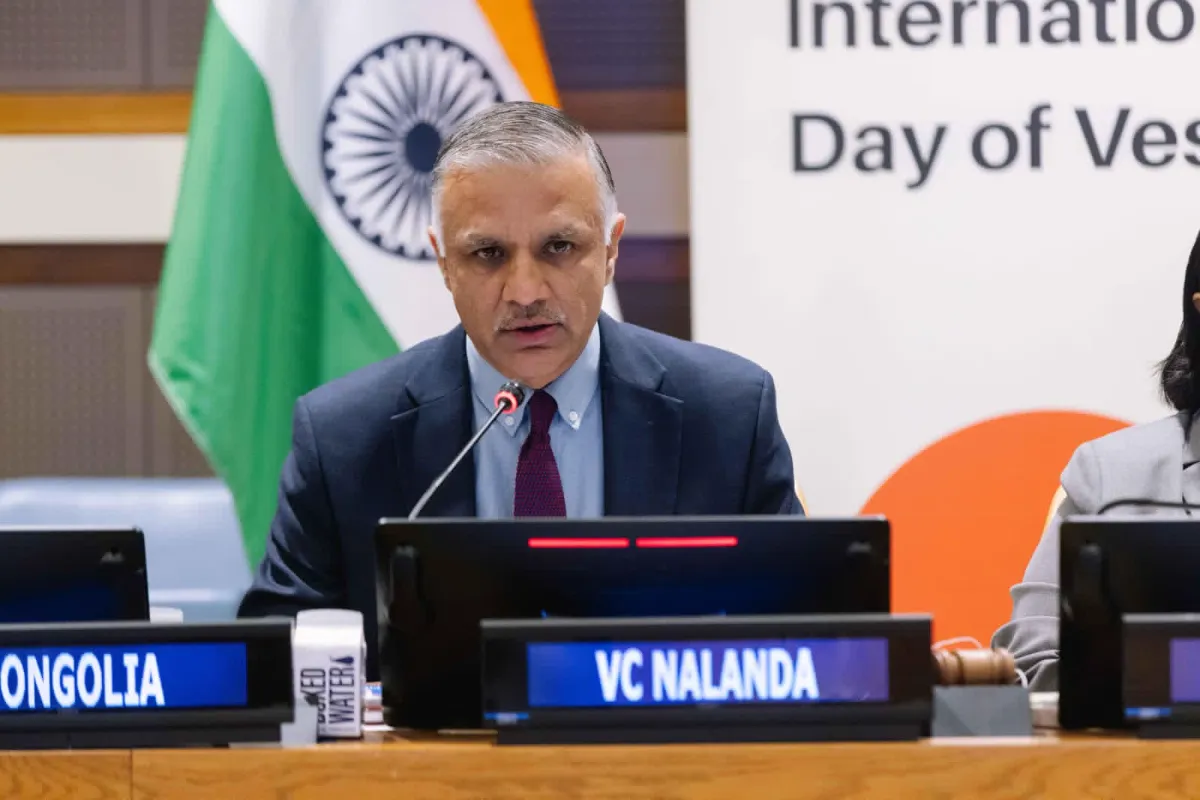
Professor Sachin Chaturvedi, Vice Chancellor of Nalanda University, delivered the Keynote Address at the International Vesak Day commemorations held at the United Nations Headquarters.
Rajgir, Nalanda, Bihar: On the occasion of Buddha Purnima, Nalanda University marked its growing global engagement through participation in high-level international dialogues in New York, including the International Vesak Day programme at the United Nations along with an academic engagement in Nepal organised by Embassy of India in Nepal.
Professor Sachin Chaturvedi, Vice Chancellor of Nalanda University, delivered the Keynote Address at the International Vesak Day commemorations held at the United Nations Headquarters, New York, on the theme “Leveraging Buddhist Heritage for Strengthening Global Peace and Cooperation.”
In his address, Professor Chaturvedi underscored the enduring relevance of Buddhist philosophy in addressing contemporary global challenges, emphasising interdependence, collective welfare, and ethical development as foundational to global governance. Drawing upon Nalanda’s historic legacy as the world’s first international residential university, he highlighted its revival as a living civilisational bridge encouraging dialogue across cultures and nations.
He argued that culture remains a “missing foundation” in the global development agenda, noting the absence of a dedicated cultural goal within the Sustainable Development Goals (SDGs). Stressing the need for a post-2030 development framework, he called for integrating culture and ethics as structural pillars of sustainable and inclusive global progress.
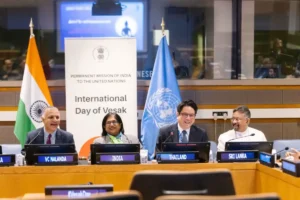
Highlighting key Buddhist concepts such as Pratītyasamutpāda (interdependence), Sammā Ājīva (right livelihood), and Jagathita (well-being of all), Professor Chaturvedi articulated a framework where peace is not merely the absence of conflict but the outcome of ethical consciousness and shared responsibility. He further emphasised that Buddhist heritage – both artistic and philosophical – constitutes a vital global common that can strengthen multilateral cooperation and cultural understanding.
On the sidelines of the Vesak commemorations, the Nalanda University delegation also interacted with Ambassador Yojna Patel, Deputy Permanent Representative and Ambassador at the Permanent Mission of India to the United Nations, acknowledging her support in facilitating meaningful dialogue.
The events witnessed participation from multiple Member States, including Bhutan, Cambodia, Japan, Laos, Mongolia, Nepal, the Republic of Korea, Sri Lanka, and Vietnam, reaffirming a shared commitment to peace, dialogue, and cooperation inspired by Buddhist heritage.
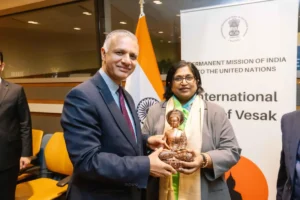
In a parallel engagement, the Consulate General of India, New York, in collaboration with Nalanda University, hosted a distinguished roundtable on Buddhism, bringing together leading scholars and academics from the United States. The Nalanda delegation, led by Professor Sachin Chaturvedi, presented a comprehensive overview of the University’s ongoing research, academic initiatives, and its commitment to promoting meaningful international collaborations rooted in shared civilisational knowledge traditions. Participating scholars appreciated Nalanda’s efforts to re-emerge as a global centre of learning and engaged in enriching discussions on strengthening academic partnerships. Nalanda University expresses its sincere gratitude to Ambassador Binaya Pradhan, Consul General of India in New York, for his gracious support and facilitation of this dialogue.
In another event in Nepal, Dr. Pranshu Samdarshi, Assistant Professor at Nalanda University, was invited by the Embassy of India Kathmandu to address an academic seminar held at Lumbini Buddhist University.
At the event held at the birthplace of the Buddha, he emphasised the Buddhist philosophical framework as a means to understand the deep civilisational interconnections and mutual interdependence between India and Nepal. He noted that the shared heritage of Buddhism provides a profound foundation for fostering harmony, cooperation, and sustainable development that may further strengthen engagement and advancing collaborative development between the two countries.
–From A Correspondent
About the Author