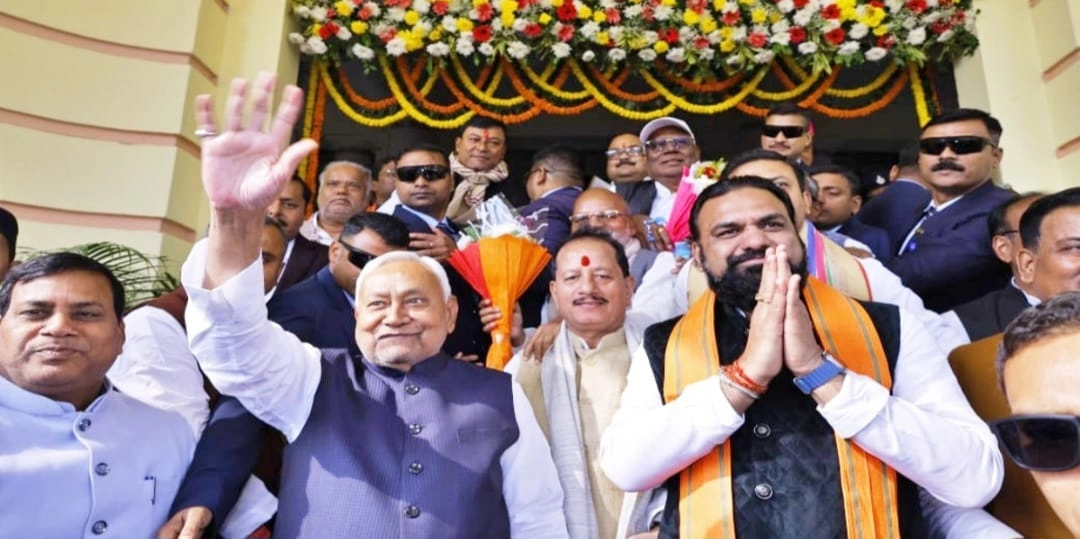
Bihar Chief Minister Nitish Kumar
By Neeraj Kumar
Patna: In Bihar, *Kharmas* is traditionally regarded as an inauspicious period during which no auspicious activities are undertaken. Political parties, too, attach significance to this period and generally implement major decisions only after it ends. Kharmas, which began on December 16, 2025, will continue until January 14, 2026. With its conclusion on January 15, the commencement of auspicious activities is expected, and a long-anticipated expansion of the Bihar Cabinet is now considered almost certain after that date.
Following the Bihar Assembly elections, 26 ministers were sworn in along with Chief Minister Nitish Kumar. However, Nitish Nabin resigned after being appointed BJP’s National Executive President, reducing the number of ministers to 25.
As per legislative strength, Bihar can have a maximum of 36 ministers, including the Chief Minister. This leaves room for 10 more ministers—six from the Janata Dal (United) quota and four from the BJP. Political discussions suggest that the cabinet expansion will take place once Kharmas ends.
During his recent visit to Delhi, Chief Minister Nitish Kumar held discussions on the issue with the Prime Minister, the Union Home Minister, and senior BJP leaders. Both JD(U) and BJP may re-induct some former ministers, while new faces are also expected. Nitish Kumar is reportedly keeping an eye on leaders from other parties as well, indicating possible political realignments.
The Bihar Assembly has 243 members, while the Legislative Council has 75 members, with four seats currently vacant. In the Assembly elections, the NDA secured a decisive victory, winning 202 seats. Based on these numbers, the state is entitled to a 36-member council of ministers.
When Nitish Kumar returned to the NDA in 2024, the cabinet was expanded to its full strength of 36 ministers, including the Chief Minister. This time, despite the NDA’s landslide victory, only 27 ministers were inducted initially, leaving nine posts vacant. Following Nitish Nabin’s resignation, the number of vacancies has risen to 10.
The Chief Minister had earlier indicated that cabinet expansion would take place after Kharmas. Meanwhile, the BJP elevated Nitish Nabin to a national post, prompting his resignation from the state cabinet. Currently, JD(U) has the Chief Minister and eight other ministers, while the BJP has 13 ministers. The Lok Janshakti Party (Ram Vilas) has two ministers, and HAM and the Rashtriya Lok Morcha have one minister each.
Caste and social balance have been carefully maintained in the present cabinet. Ministers include eight from the OBC category, eight from the upper castes, six from the Kurmi–Kushwaha communities, and five from the Dalit community. In terms of caste representation, there are five Dalits, four Rajputs, three Kushwahas, two each from Kurmi, Vaishya, Yadav, Mallah and Bhumihar communities, and one each from Brahmin, Kayastha, Chandravanshi and Muslim communities.
Several former JD(U) ministers who were not included this time—Jayant Raj, Ratnesh Sada, Maheshwar Hazari, Vijay Mandal and Sheela Kumari—are hopeful of a return. Among them, Maheshwar Hazari is considered a strong contender, while Sheela Kumari is seen as a leading female aspirant.
On the BJP side, leaders not inducted into the current cabinet include Nitish Mishra, Renu Devi, Janak Ram, Santosh Singh, Neeraj Kumar Singh, Kedar Prasad Gupta, Hari Sahni, Raju Kumar Singh, Motilal Prasad, Krishna Kumar ‘Mantu’, Jivesh Kumar and Sanjay Saraogi. Sanjay Saraogi has since been appointed BJP’s state president. From the Mithila region, Nitish Mishra’s name is frequently mentioned as a likely inclusion.
At the time of cabinet formation, 27 ministers were inducted, including 14 from the BJP. After Nitish Nabin’s resignation, the BJP’s tally has come down to 13.
Among the current ministers are Samrat Choudhary from Tarapur in Munger (Kushwaha community), Vijay Sinha from Lakhisarai (Bhumihar), Dilip Jaiswal from Kishanganj (Vaishya), and Mangal Pandey from Siwan (Brahmin). Nitin Nabin from Patna (Kayastha) was also part of the cabinet before resigning. Other ministers include Surendra Mehta (Kushwaha), Sanjay Tiger and Shreyasi Singh (Rajput), Arun Shankar Prasad (Sudhi), Ram Kripal Yadav (Yadav), Lakhendra Paswan (Paswan), Rama Nishad (Mallah), and Narayan Shah from the Extremely Backward Classes.
From the JD(U) quota, nine ministers were inducted, including Nitish Kumar and Shravan Kumar (Kurmi), Bijendra Yadav (Yadav), Vijay Choudhary (Bhumihar), Madan Sahni (Mallah), Ashok Choudhary and Sunil Kumar (Dalit), Lesi Singh (Rajput) and Muslim leader Jama Khan.
Rajput leader Sanjay Singh and Paswan leader Sanjay Paswan were also made ministers. HAM was given one berth, with Santosh Kumar Suman, son of Jitan Ram Manjhi, inducted. The Rashtriya Lok Morcha also received one ministerial post, with Upendra Kushwaha’s son appointed despite not being a member of either House.
Political analyst Professor Pramod Kumar said a cabinet expansion after Kharmas is highly likely, with 10 posts currently vacant. He noted that caste and social equations would play a key role, along with regional balance. Divisions with lower representation are likely to be prioritised, while regions such as Mithila, which have consistently supported the NDA, may see increased representation. Saran and Shahabad divisions could also gain more ministers.
Professor Kumar added that Nitish Kumar is widely regarded as a master of social engineering, while the BJP, under Amit Shah’s guidance, will also factor in electoral calculations. Dalit and Extremely Backward Class representation may be increased. With Nitish Nabin’s exit, Kayastha representation could be restored, and JD(U)’s share in the cabinet may rise. The BJP’s ministerial strength is also expected to increase.
There is also speculation that legislators from opposition parties may be accommodated, potentially altering political equations. Although the NDA enjoys a comfortable majority, it is closely watching the opposition, which currently has just 41 MLAs in total—25 from the RJD, six from the Congress, five from AIMIM, three from Left parties, one from the BSP and one from the IIP.
Political circles suggest that vacant cabinet posts were deliberately kept to facilitate possible defections by offering ministerial positions. Speculation is rife that major political developments could follow the traditional *chooda-dahi* feast, with the cabinet expansion also being shaped by an eye on future elections.
About the Author