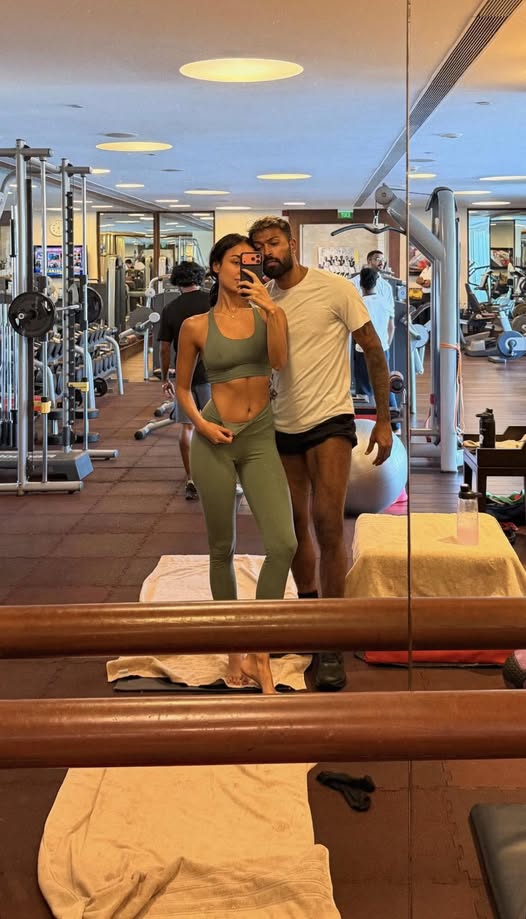
Mahieka Sharma and Hardik Pandya. Photo courtesy; Facebook
Mumbai, India:
Indian cricket star Hardik Pandya has found himself at the centre of another social-media storm, this time for speaking out against the filming of actor and model Mahieka Sharma by paparazzi during what he described as a “private, harmless moment” that was “turned cheap for clicks”. The sharpness of the reaction again fired up the long-running debate around celebrity privacy, media ethics, and digital culture that is becoming progressively intrusive.
The incident in question unfolded earlier this week when a short video clip featuring Mahieka Sharma surfaced on several entertainment portals and social-media pages. While the content of the clip appeared innocuous, the angle and framing—recorded without consent—suggested it was captured in a hidden manner. What truly sparked outrage, however, was the sensationalized captioning and insinuations added by various outlets, attempting to fuel gossip about Pandya and Sharma.
Pandya has often spoken out against intrusive media behavior, and he reacted quickly to the incident on social media. Sharing a screenshot of the video on his Instagram Stories, he wrote a strongly-worded note, which was directed to the paparazzi who shot the video. “Private moment, shot without permission and cut for cheap engagement—this is not journalism. It’s harassment,” he wrote. “If this is what it takes to get views, I’d rather not be part of your narrative.”
His comments garnered widespread attention as fans, fellow cricketers, and members of the entertainment industry alike rallied around him. A number of people praised him for having spoken out against unethical coverage that tends to trample over personal space in the name of increasing reach and relevance.
Mahieka Sharma herself then broke her silence shortly afterwards. In a released statement, she said that she felt “violated and disappointed”, adding that she was just having an ordinary day when the footage was shot. “I didn’t even realise someone was filming me. To see something so ordinary being misrepresented online was unsettling,” she further said. “This culture of constant surveillance is becoming alarming.”
The incident has reignited calls by celebrities for more stringent legal and regulatory protections. Though Indian laws on privacy provide limited protection, the line dividing public and private remains inconstant, as cameras follow public figures through most moments of their waking lives. The paparazzi culture—imported from Hollywood tabloids—has grown fast over the last decade in metropolitan India and is often fueled by a public that demands real-time information about the lives of celebrities.
Yet this appetite has also given rise to criticism. Editorial standards within sections of digital entertainment media are often questioned, particularly as portals compete for clicks, reposts, and viral moments. Sensationalism, exaggeration and ambiguous insinuations have become worryingly common. Pandya’s reaction has thus reopened a conversation about whether the media’s race for visibility has erased the basic respect owed to individuals, even those in the public eye.
This is not the first time Pandya has clashed with intrusive coverage. A high-profile cricketer whose personal life is dissected almost daily, he has called upon the media to draw a line, especially when his family is concerned. The general drift of many celebrity-centric platforms from professional achievement reporting to speculation amplification, private disputes, or moments captured in vulnerable settings does not go unnoticed by observers.
Social-media users echoed similar sentiments, with thousands pointing out that what had happened to Sharma represented a far greater issue: privacy violations masquerading as “content”. In particular, this outrage targeted outlets that monetise the clips without any accountability. Others questioned why female celebrities are held up under such scrutiny, with some pointing to a pattern where their images become circulated with salacious headlines to maximize engagement.
Meanwhile, industry commentators say that the situation calls for a more responsible approach. “There is a difference between covering public appearances and recording individuals without consent, especially in personal spaces,” said a Mumbai-based media ethicist. “If the purpose is merely to provoke speculation, it becomes a breach of trust between journalists and the public.”
Bollywood personalities also waded into the debate. A number of actors shared Pandya’s post, frustrated with paparazzi who cross their boundaries in the hope of breaking a story. One observed that though associations with the media are an indispensable accompaniment to fame, “being constantly hunted is not part of the deal.”
To Sharma, however, this episode has brought in sympathetic support from her fandom. The fans highlighted that trying to implicate her in celebrity gossip without context was uncalled-for. Sharma and Pandya have not clarified how they know each other; however, both have expressed that the narrative constructed from the video was false and sensationalised for traffic.
Quite interestingly, a few accounts by paparazzi tried to justify the recording, saying that capturing celebrities even in public areas is part of their job. Critics contested this on the basis that no “anything in public is fair game” rationale can ever supersede ethical responsibility. The motivation behind filming-whether news or salacious storytelling-is central in determining appropriateness.
Pandya’s complaint also reflects a broader generational shift. Younger celebrities and influencers, who rely heavily on digital platforms to engage with audiences, have become increasingly vocal about demanding respectful boundaries. Unlike film stars of previous decades who rarely, if ever, challenged media portrayal publicly, today’s figures use their platforms to correct misinformation, criticise unfair behaviour and shape their own narratives.
The BCCI, despite the acrimony of the dispute, has maintained a deliberate silence, indicative of its reluctance to view this as anything other than a private issue, not cricket-related. However, sports psychologists say such intrusions affect an athlete’s well-being and impact focus and performance.
One thing is crystal clear, though, as this debate rages on: Society needs to rethink what it expects from celebrities, and what is owed to them by the media in return. While public interest plays a legitimate role in news, sensationalism masquerading as reporting risks eroding trust and contributing to a hostile environment. Pandya signed off with a plea for sensitivity. “We are human beings before anything else. Respect that,” he wrote. “If you want stories, talk about our work—our wins, our losses, our journeys. Don’t turn dignity into entertainment.” His words have resonated widely, becoming a rallying cry for those tired of the tabloidisation of everyday life. Whether this incident would spark meaningful change remains uncertain, but it has undoubtedly made the industry and its audience confront the consequences of reducing privacy to a commodity. For now, the spotlight stays on a conversation long overdue: the balance between curiosity and intrusion. And in speaking up, Hardik Pandya and Mahieka Sharma could well have done more than defend their own moment-they may have set the stage for a much-needed reckoning in India’s rapidly evolving media landscape.
About the Author